Showing posts with label existence of God. Show all posts

Monday, October 5, 2015

Review of Hermon Philipse's God in the Age of Science (Part 2)


He uses the issue of of explanatory power to justify using Bayes to establish the illusion of technique for deciding the matter.[24]Of course his explanatory power is a scientific explanation but he never bothers to justify it. A scientific explanation would have to be limited to the workings of the physical world and modern theology doesn't claim to answer that. Swinburne finds God probable in the prior[25] (Bayes works by establishing a prior probability as a basis from which to begin calculations). The problem is Swinburne uses simplicity as the criterion to set the prior. Philipse apparently can't dispute it. Thus, he objects to simplicity as the criterion rather than try to argue that God is complex as did Dawkins (see above). He argues against simplicity as criterion on the basis of lack of empirical evidence. He then takes up the issue of final cause. Theists sometimes use final cause as an “ultimate explanation.” “God forms a more natural stopping place [for theists] than, say, the existence of the universe.”[26] The existence of the universe is what is in question so of course that in itself can't prove its origin. He is calling into question the satisfying nature of final cause, apparently assuming that the infinite causal regress (ICR) is not unsatisfying. He asserts that defense of God as explanation can't be “full” and “final” because it doesn't answer the kinds of questions science answers. He couches this in terms of introducing “questionable metaphysical assumptions.”[27] It seems that they are talking at cross purposes because each means something different by “full” and “complete.” For Swinburne this is causal and includes motivations. Philipse contrasts motivations as part of the cause with naturalistic explanations which are about “causal laws of nature.”[28] So Swinbure is talking about “why” and Philipse is talking about how. It may be a matter of taste but it seems that asking after why is a philosophical view and more satisfying in some ways, whereas the scientific explanation has to exclude why as though there is not one and that seems less “full” as an explanation. If there is no why there is none but why should we just assume a priori there is none? If the explanation is only a scientific one then that is what we must do. That's why we should prefer the philosophical and asked “is there a why?” When we find one that should be it.

At this point he brings in what he takes to be the ultimate “brute fact” of God's existence as a negation of a complete explanation. In order to pull this off he establishes synchronic and diachronic both as requirements of a “complete” explanation.[29] The former refers to causes immediately temporal effecting the given outcome, while the latter entails causes perpetuated through time before the event. In other words, synchronic, the match burst into flame due to friction caused by the striking board. Diachronic, the match burst into flame due to the factory used to make chemicals, applied these chemicals to the match at a given time, and the store that sold the matches and every other aspect of buying the matches, up though the motion of my hand of running the match along the striking board. So he's saying that because we don't have that sort of knowledge about God then God can't be a full explanation. Then he's going to spend a lot of time picking apart the motivations of God, such as the motivation to create humanity.[30]Because we can't understand God's exact motivations, nor is there a set of diachronic explanations for God's being, then the explanation can't be full.

There are two problems with this argument. Philipse has defined “full explanation” and “ultimate” explanations in ways that favor scientific kinds of information. The philosophical understanding does not necessarily require the same kinds of explanation. Why do we need to know, for example, what exactly God's motivation to make man felt like or even what it was? We can understand the motivation of love, all of God's motivations can be summed up in love. The demand for scientific exactitude is a smokescreen. We might qualify “full” and “complete” and limit it to matters we can understand. God as the final explanation can be based upon both the final cause and the bestowing of meaning via reasons for our own existence; these have to be in general terms such as “love” because we can understand love (at least on an instinctive level). The second problem has to do with the idea of God as brute fact (BF).

The concept of brute fact turns upon the notion of their being no reason for the BF. A BF is a fact for which there is no reason at all. That's not to say no cause but no reason other than the naturalistic causal nexus of the physical world. The BF is a slippery concept because many philosophers mean different things by the term. John Hospers understands BF simply as something that can't be explained.[31] Does this mean we don't even know a scientific cause? For Some Philosophers it does and for some it does not. Eric Barnes lists several philosophers who use the term to mean no known explanation, not even a scientific one (Freidman, Kitcher, Lipton).[32] Barnes himself says “it is my view that brute facts need not be thought to represent any gap whatsoever in scientific understanding.”[33]We can side step the problem because we can't get a scientific explanation of God. God is not given in sense data, thus it is an a priori truth that we can't have a scientific explanation of God. To say that without a scientific explanation we have not a full or complete explanation is merely to exchange one set of metaphysical assumptions for another. Privileging science as the only valid form of knowledge is just as much a metaphysical assumption as is belief in God.

Moreover, these are two fundamentally different kinds of explanations, scientific and purposive. There is no purpose in naturalistic processes and forces of nature. If that is all there is then all reality is a brute fact. For me brute fact means no higher reason than just bare existential facts. There is no higher purposive reason for God than God. That is not the same as saying the world just happens to be here for no reason other than the natural causal connections involved in its coming to be. Naturalistic processes are all cause and effect, they are all contingent. That puts God on a different level than anything else. God is the only truly non contingent reality. With all temporal natural things necessities are themselves contingent upon higher necessities. That is until we come to God. We should expect that the process of necessity and contingency would keep on going, although that leads to questions about infinite causal regress (ICR). If there is ICR it's not there for a reason. But God gives us not only a stopping point for causes but also a higher purpose in life.

That explanation is more full in terms of purpose and more complete in terms of causation. This reasoning could be circular if one is not careful. It begs the question to assert that there must be a “higher level” reason. But the opposite is also true; the assumption that there isn't a higher reason also begs the question. One way around this is to embrace the final cause argument. Another way would be to take it as axiomatic based upon proper basicality or some intuitive sense or experience that there is higher purpose.

At this point Philipse turns to Bayes theorem as a means od proving God is not probable. So he moves from denuding the empitus for belief by calling it "unscientific" to a reason not to beliebe. I have shown that Bayes can't be applied to God.
My Answer to Lowder's attack on my Bayes article
24 Ibid., 91

25-27 Ibid. 192

28 Ibid. 195

29 193

30 i95

31 John Hospers, An Introduction to Philosophical Analysis (1997) p. 211

32 Eric Barnes, “Explaining Brute Facts,” PSA: Proceedings of the biennial Meeting of The Philosophy of Science Association.. Vol 1994, Volume one: Contributed Papers, (1994), 64-68, 64.

33 Ibid.

Thursday, October 1, 2015

Review of Herman Philipse's: God in the Age of Science. (Part 1 of 2)


[]: Philipse makes three major moves indicative of the scientistic ideology. Rather than deal with his entire book I will isolate those points and show how they exhibit the ideology. Those three points are:

I. God, as an explanation of the world and any meaning in life, must be derived by scientific methods and must constitute a scientific explanation. Only scientific answers are real proof and can be checked by others, This is reduction of all knowledge to the only valid kind of knowledge: science.:

II. He uses that position to leverage the battle on to his own turf, The proofs of God must be scientific proofs, therefore he totally discounts revelation.:

III. Having moved the battle to his own turf he argues against Swinburne's use of Bayes so that he can use it as the scientific evidence. Having established that only scientific evidence will do then he's the only one in the debate with scientific evidence.:

The way he accomplishes move I is by dispensing with revelation and personal experience. His first chapter argues for the priority of natural theology. [1] The establishment of that point is really based upon the supposed weakness of revelatory knowledge.[2]Essentially he asserts that only natural theology can be checked by others, revelation and personal experience are unreliable and subjective. He constructs four dilemmas for the believer designed to leverage her into fighting the battle on his own turf. The first such dilemma is between what he calls “cognitive and non-cognitive.” By non cognitive he may include experiences, but he's speaking more directly of liberal theology, that tends to be metaphorical vs. a factual account. He says, “according to...cognitive interpretations a believer who says 'God exists' is making a factual claim which is either true or false, whereas according to non-cognitive interpretation such sayings have a very different function. Evaluation of these statements in terms of truth or falsity is inappropriate.[3]His examples of non-cognitive are Wittgenstein and Karen Armstrong. The non-cognitive makes belief immune to criticism but also leaves it cut off from non-believers as unprovable.

For the “cognitive believer” there's a second dilemma. Either belief must be backed by evidence or it's not needed.[4] An example of the latter is the work of Alvin Plantinga and his idea of “properly basic beliefs.” In that view belief is rationally warranted though not proven to others. Philipse answers Plantinga, “I shall argue that religious beliefs, and indeed most religious believers, not be called justified or reasonable or warranted unless the latter...can support their beliefs by abducinng good positive reasons to the effect that these beliefs are true.”[5]Here's where he starts leveraging the believer off the ground that makes strong faith (experience) and onto his turf where he controls the landscape (that of scientific knowledge). He says, “...these reasons [the believer's justification for belief] shall not derive from, or not derive merely from, a revelation or from faith. In other words rational or natural theology is indispensable to modern religious believers, if at least they want to be called 'reasonable,'” [6] Either bring religion into compliance with the priesthood of knowledge (science) or the gate keepers will slam the door in your face and you will be obsolete. Either way religion loses.

He brings out the next dilemma, either the methods used to defend belief will be scientific or not scientific. He says “both horns imply great peril for the believer.”[7] In debate we avoided that position by exposing the false premises upon which the dilemma was based. Most dilemmas are like a long horn steer, a point here, a point there, and a lot of bull in between.[8] First of all abductive reasoning means inference from the best explanation. That does not require proof and it may not involve establishing facts. He's going to have to prove that the best explanations are always and only the scientific ones. To assert that only the scientific answers count means that he reduces all knowledge to science. Secondly he's done a bait and switch in that he's demanded science but clearly substitutes the fortress of facts. Moreover, there is a distinction between warrant for the belief of the believer and warrant for an argument that will persuade others. The former is what Plantinga speaks to, the latter is Philipse's demand. Obviously revelatory proofs will mean more to the one who had the revelation. We can't let others in on it. So personal experience could be valid and warrant belief even if it does not function as proof for others. Personal experience, however, can function as warrant even for others, we do have scientific evidence, I will get to that in a bit.

Let's look at his three dilemmas. The first is factual and non factual. In the non factual camp he really includes liberalism and non literal views of theology. That's important because he has to get the believer on his turf, the fortress of facts. Apparently that's what he means by “science,” the fact producing machine. It is possible to employ metaphor in a belief system without reducing belief in God as a stark choice of either fact or metaphor. The second dilemma is for the so called “cognitive side” (for that I read “literalistic,”) it must be backed up or not. I say it only needs backing up if one needs to prove to others. Otherwise we all have reasons for believing, and if faith is sincere those reasons can only be life transforming. There's nothing irrational about that. If something is so overpowering it can't be denied and if it changes your life dramatically for the better it would be irrational to refuse it merely because it's not part of the truth regime. The third I just discussed, the demand for scientific evidence.

A major problem here is that he has these neat segmented little compartments, where reason and faith are kept apart; where natural theology and reformed theology are kept apart. Real faith and real religious thought is not like that. People have both faith and reason, revelation and objective proofs. It is perfectly possible to mix the two sides and most of us do to some extent (with a thousand variations of degree). We really need to take to heart the distinction between personal faith and the desire to convey one's reasons to others. No one believes for no reason. Belief is an existential/phenomenological matter. It's not a test for a driver's license. The scrutiny I have to care about is my own and that of those I love. When Philipse says things like, “...for modern believers faith is not an epistemic virtue but a vice, unless there are convincing arguments for the truth of its contents,”[9] there is no reason to credit that statement. Convincing to whom? The only person I have to convince is me. I do have reasons I find powerful and if others would not find them so more is the pity for them.

He says modern believers are in a methodological dilemma. “Do They have at their disposal reliable and validated methods of religious research? If so it seems that the content of their faith can be refuted...”[10] If it can be validated it can be refuted. That goes for all positions. I was a college debater I can refute anything. Actually that's not a dilemma it's a double bind. He's saying if it's validated that's bad, then he blames it because it's not validated. “...If not, [validated] how can a religious creed be credible at all in our scientific era?”[11] That depends upon who is doing the validating and upon what basis.. The philosopher kings have been in the ivory tower too long. That statement in and of itself screams ideology. Why should religion not be credible merely because we are in an age of science? We all believe for a reason, modern people have modern reasons.

Of course Philipse, brilliant and rigorous though he is, seems blissfully unaware of the fact that there is good scientific evidence backing up many aspects of religious faith. In the chapter on supernatural I will discuss the vast body of empirical work backing the veracity of religious experience; the skeptic really has no justification for dismissing experience as evidence, they way Philipse does. The “M scale” gives us a scientific means of control for understanding what is a valid experience and what is not (see chapter on supernatural). By the same token the same chapter also documents unexplained events well documented and factual form the basis for modern miracle claims. These both experiences and miracles are controlled for and validated by double blind experiments and medical diagnostics. Even so its only if one intends to persuade the skeptic that one needs to meet the demand for evidence. Then evidence need not be scientific. Yet we do have the validated scientific methods, I wrote a book about them.[12]
(to understand the studies proving scientific methods for a God Argument see the summary of my book on my blog "The Trace of God).
He continues more of the water tight compartmentalizing by stating that there are so many contradictions in the “traditional concept of God.”[13] Then the most troubling part, “without introducing analogy or metaphor...” Why should we want to avoid analogy and metaphor? That's rather irrational since we can't talk without them. It's not the literalistic aspect that makes language work as communication but the space afforded understanding in the use of analogical speech. Not only is all religious language analogical but all language is to some extent.[14]That is a major method in theology, use what we know in analogy to communicate in the face of the unknown. Yes, it can be inaccurate, but how accurate does it have to be? Why doesn't the fact that we have no empirical proof of string theory or multiverse stop scientists from talking about those things? Personal belief is a phenomenological matter. The short cut to defining that term: metaphysics imposes pre set categories upon sense data, phenomenology is allowing the sense data to suggest its own categories. In equating metaphor with untruth he is imposing many preset categories (ideology) upon the sense data.

Philipse associates literal language (no analogy or metaphor) with being reasonable defined as “objective diachronical rationality”). [15]I disagree that “objective” opposes metaphor. One can be objective about the use of metaphor. I certainly object to the implication that metaphor is irrational. To use metaphor properly one must reason about meaning and implication. Since belief is a phenomenological pursuit it requires an individual understanding. It's not science nor can it be. We just have to accept that science is not the only avenue for reason. One can be rational and reason in the continental style of philosophy, using phenomenology for example. The compartmentalizing is a hindrance. That seems to be the ideology of scientism. That's an upshot of the reduction of all knowledge to science.

He equates belief in God with a scientific hypothesis and demands of it the kind of explanatory power one finds in science. Rather he asks (rhetorically) “...whether theism can be an explanatory theory or hypothesis at all.” [16]That rather depends upon what one means by “explanatory.” What kind of explanation are we seeking? Why should it be a scientific hypothesis? It's not meant to be one. One does not dedicate one's life to a mere hypothesis. Hypotheses are meant to be tested. We can't test God. Take the Lord out for a test prayer! Science works by testing ideas and culling bad one's until the last one not culled is assumed true. It's not proved its just assumed (see chapter 3, Popper). To that extent Paul Tillich's notion of theology is scientific.[17]Tillich's “method of correlation” in which he “attempts to correlate the various analyses of the human predicament produced in modern culture with the answers provided by the symbols used in the Christian message.”[18] This a sort of hypothesis testing where one is comparing empirical experience to “theory” (doctrine). This is not to say, however, that doctrine is at all like an hypothesis. Nor is it intended to be. Philipse's demand is an example of the reduction of all knowledge to science. Yet Philipse demands that an understanding history be included to be rational (“diachronical”). Tillich said that the sources for doing theology are not only the Bible but history and culture as well. Moreover, he spoke of theology as explaining the meaning in the human condition.[19] That is a kind of explanatory power science does not have.

In order to counter the realization that all language is analogical he quotes Swinburne saying “...if theists cannot articulate their religious view except by using the key terms in an irreducibly analogical manner theism cannot be a theory of hypothesis.” [20] Well its not. He still has not bothered to say why it should be. In fact this line of argument seems to be a smokescreen. It's irrelevant what Swinburne makes of analogy because that doesn't answer the point that all language is analogical. The issue there revolves around the term “irreducible.” Philipse acknowledges that all language is somewhat analogical but not irreducibly so. If the term means that there is meaning present to the signifier then he's wrong, all language is irreducibly analogical. There is a literal meaning to all utterance but that doesn't mean that meaning is ever totally present in any signifier. In speaking of God we can say “God is the basis of all that is.” That is a literally true statement and yet it's fraught with ambiguity. God is beyond our understanding, we don't need words to feel love, or to know that love is real. Belief is personal and doesn't stop when you leave the lab. It's given a deep hidden personal slant multiplied times all believers, Naturally, it's not going to have the kind of precision a scientific hypothesis will have. Nor will it have the kind of explanatory power.

He does point out metaphor is used in science. He gives several examples. The mechanical model, seeing universe as a machine (eighteenth century) gives way to the organic model. These “models” are really analogies. He argues that science has clearly defined limits for such ideas but God is transcendent of our understanding so all our speech about God is completely analogy.xxi [21] The upshot is religion is not science, so religion is false because science is all that is. He argues that some people think they experience God's presence but of curse they don't. It's true that God is not given in sense data. A thing need not be amenable to our sense data in order to be real.:

Although some believers claim to have perceived God, the speakers of the language cannot be perceptually aware of God in the same unambiguous public manner in which human beings, cities, dogs, or mountains can be perceived. Hence no intersubjective referential use of 'God' can be established by such deictic methods. As a consequence one is only able to provide the proper name 'God' with a possible referent by giving a description of what the name is supposed to refer to. If no literal description is possible of an entity to which the word God allegedly refers...since that entity can only be hinted at by irreducible metaphors...we could never succeed in providing the word God with a referent.[22]
First of all, speaking a language does not in and of itself assure us a signified (referent) for our signification. It's irrelevant what the speakers perceive qua speakers. Secondly of course God is not going to be as well perceived as a tangible object, at that point he's merely saying God is not tangible, that cannot be equated with “there is no God.” Moreover, not to be pedantic but proper name is not God. That's his job description.

It is basically true that we can't communicate what God is in words because its beyond our understanding. That's why there are mystics. Lots of other things are known to exist but can't be communicated in words. Some examples include love, the colors, the feelings (try describing a feeling without referring to other feelings). Some philosophers try to deny the existence of feelings, those of us who don't need therapy know they exist. Now if it be objected that these things are not physical objects and God must be a physical object, that is an ideological assumption. There is no proof that there can't be real objects that are not physical. The disproof of Philipse's point, however, is the scientific data to which I refer in the chapter on supernatural, in connection with the M scale and Ralph Hood Jr.[23] The data proves that mystics around the world in all faiths are having the same kinds of experiences. These can be separated from physical causes of brain chemistry, drugs, perceptual problems and the like. Not only do they have an intersubjetive basis for referent but that basis furnishes good evidence of a reality external to their own minds which they all experience. The differences in those experiences are the doctrines used to explain them, that acts as a cultural filter, not the experiences themselves.

part two monday

Sources

1 Herman Philipse, God In The Age of Science, Oxford, London: Oxford University Press, 2012, 3

2 Ibid 23

3 Ibid., xiv

4 Ibid-xv

5-8 Ibid

9 Way back in the Trojan war, when I was in high school debate the Dallas Jesuit debators used that saying, that's where I got it.1973-74. Jesuit was the top school having won NFL district championship 3 years in a row (1972, 73, 74).

10 Ibid xvi

11 Ibid

12 Joseph Hinman, The Trace of God: a Rational Warrant doe Belief, Colorado Springs: Grand Viaduct, 2014. no page indicated. This book is only available on amazon.com. It covers a host of methodologies in over 200 studies on religious experience forming a huge body of work going back to the 19960s. Of these the chief study instrument is the “M Scale.”

13 Philipse xvi

14 Phiipse acknowledges this, 95

15 Ibid., 95

16 Ibid.

17 Guyton B Hamond, “An Examination of Tillich's Method of Correlation,” Journal of Bible and Religion, 1964,Vol. 32, No. 3 (Jul., 1964), pp. 248-251, 24

18 Ibid.

19 Philipse, 96

20 Ibid.

21 Ibid., 97

22 Find chapter and fn on Hood article.

23, Ibid,91

Wednesday, May 15, 2013

Atheists Battle Their Super Egos

Photobucket


I have often accused atheists of only being able to understand the big man in the sky rather than more expansive views of God, such as process theology or Existential ontology. But I've slowly begun to realize that they really are using "God of the Bible" as a means of venting in a cathartic process of battling their own super egos. Look at the way they sound when they rant about how evil God is, they sound like teenagers who have just moved out of the house becuase they an't stand their father. One such prime example is that of a poster on carm:Roarian


Indeed, I would put him straight in the category of malevolent and elitist : he doesn't care one bit about what you did with your life or what you believed, but merely what you did not believe : if you weren't a part of his posse, you're out forever.

Can't you just hear a pot smoking kid of the 60s saying 'Dad doesn't care about me?' not that I mean to belittle this guy's feelings by saying that. Most guys my age have been there, even with the pot smoking. The fear that God is only concerned with penalizing you for believing wrong things rather than with how good you may be because you believe a few right things, this is not only a tortured understanding of the Gospel, but also reminds me so deeply of a wounded kid in a struggle with his/her father.


Instead of giving all people an equal and fair chance at getting it right, he makes an imperfect world that is extraordinarily bad for getting 'good souls' if you will : he knows beforehand that billions upon billions will never even hear of him, and billions of others will be brought up in opposing beliefs, which are in this world equally unsupported by any evidence.

Such complaints are fraught with misunderstandings. As Christians we look at the wonderful love of Jesus dying on the cross for your sins and at the parables of Shepard chasing down lost sheep out of pure love. The atheist is the wounded inner soul who looks at the fear that he's being held accountable for getting it wrong. No attempt to reason about the nature of theodicy. Of course there are plenty of theories one could support, C.S. Lewis the Problem of Pain, or dare I say in the same breath (not to compare) My own Soteriolgoical Drama. Which I think covers the bases pretty effectively. The issues of billions and billions who will never know Jesus existed (where do these guy's live?) going to hell because they are in the wrong religion is merely an outright misunderstanding of the Gospels which is countered by Paul himself in two different books.


He then expects everyone to just go on faith that this particular religion among thousands is correct. He has his instructions penned down and translated several times, many of which incorrectly, in a tome some 2000 years ago in a sparsely populated area of the world.

The atheist's special vehement hatred of the Bible must be brought into it because its one of the few concrete pieces of data they actually have that's not just opinion. The understanding what we are to do in spreading the Gospel is of course totally inadequacy since it assumed the wrong translation of the Great commission* and does not come to terms with the concept of being a witness or spreading the love of God. These unhappy creatures who can't find their creator because they want to look in the right way think that it's all a matter of just spouting the right cods; we as Christians let them down when we fail to show by example that its not about bringing belief to the world but bringing God's' love to the world.


He then sits around and billions continue to die without ever being able to even known Christianity, while the bible writers sit around waiting to be inspired, finally in 300 AD or such resulting in the Bible.

But of cousre this view that God is "sitting around" rather than working every moment to draw people to himself is indicative of their lack of receptivity and their own refusal to respond. Of cousre he must mix it with the hatred of the Bible because that's really their own tangible piece of evidence, which is largely based upon poor reading skills.


This book is so poorly written that it is then misinterpreted and used as an excuse for hatred,
Poorly written. Has he ever ever read it? It's written in Greek and Hebrew you know. Most likely he's only a translation so he really don't know how it's written. Since he probably doesn't read it daily but relies upon atheist message boards to spread his venom and only cares about finding contradictions not finding value in it he really has no room to talk. Sure enough he has no argument to make as these are nothing more than platitudes he's mouthing.


and millions head to hell because of internal strife between different factions of his one chosen people, sending millions more to hell because nobody can agree on the correct religion and wars and dark ages break out. This all goes on for about 1700 years, ultimately ending up today, where a guy called Metacrock would call him omni-benevolent.


Of course it's only going on in his imagination because he's making fundamentalist assumptions instead of seeking to truly understand the Gospels.

Popular misconceptions of the nature of the Gospel.

"Gospel" means "Good News." The Good News is not that people are going to hell. The Good News is that God cares and provides a way to orient our lives toward him so that we can know him in this life, and in the world to come.

Are there really well meaning people?

"All have sinned and fallen short of the Glory of God." From a human perspective, relatively speaking from one human to another there are, of course, well meaning people. There are good people all around us, from a human perspective. Relative to the Divine however, no one is good, no one is capable of meriting salvation. We all have our sins, we all have our human frailties. We are all caught up in "height" (our ability through the image of God in which we were created to move beyond our human finitude and seek the good) and "depth" (our nature burdened in the sinful wickedness to human deceit).

These are Augustinian terms and they basically mean that we are both, good and bad, saint and sinner. God knows the heart, He Knows what we truly seek. God is merciful and is able to forgive our trespasses. But, if we are really well meaning toward God we will seek the truth. If we are seeking the truth than God will make it plan to us.

Other Religions

Paul said "To those who through persistence seek glory, honor and mortality he will give eternal life.But for those who are self-seeking and who reject the good and follow evil there will be wrath and anger...first for the Jew and then for the gentile; but glory honor and peace for everyone who does good. For God does not show favoritism. All who sin apart from the law will perish apart form the law and all who sin under the law will be judged by the law. For it is not those who hear the law who are righteous in God's sight, it is those who obey the law who will be declared righteous.

Indeed when Gentiles who do not have the law, do by nature things required by the law, they are a law for themselves even though they do not have the law, since they show that the requirement of the law are written on their hearts, their consciences bearing witness and their hearts now accusing, now even defending them..." (Romans 2:7-15). New American Standard and other translations say "their hearts accusing, now excusing them..." Most Christians are afraid of this conclusion and they down play this verse. Often Evangelicals will come back and say "he makes it clear in the next passage that no one can really follow the law on their hearts." Well, if they can't, than they can't. But if they can, and do, than God will excuse them. God knows the heart, we do not. The verse clearly opens the door to the possibility of salvation (although by Jesus) through a de facto arrangement in which one is seeking the good without knowing the object one is seeking (Jesus). In other words, it is possible that people in other cultures who follow the moral law written on the heart know Jesus de facto even if they don't know him overtly. Paul backs up this conclusion in Acts 17:22 Paul goes to Athens as is asked by the Athenian philosophers to explain his ideas to them.

These were pagan followers of another religion. Paul stood up and said to them, "Men of Athens, I see that in every way you are very religious for as I walked around and observed your objects of worship I even found an alter with this inscription 'TO AN UNKNOWN GOD' Now what you worship as something unknown I am going to proclaim to you."He basically says that they are worshiping God, they just don't know who he is. That's why he says "I will make it known to you." He doesn't say "you have the wrong idea completely." Most Evangelicals dismiss this as a neat rhetorical trick. But if we assume that Paul would not lie or distort his beliefs for the sake of cheap tricks, we must consider that he did not say "you are all a bunch of pagans and you are going to hell!" He essentially told them, "God is working in your culture, you do know God, but you don't know who God is. You seek him, without knowing the one you seek. He goes on,(v27)"God did this [created humanity and scattered them into different cultures] so that men would seek him and perhaps reach out and find him though he is not far form each one of us." This implies that God not only wants to work in other cultures, but that it is actually his paln to do things in this way. Perhaps through a diversity of insights we might come to know God better. Perhaps it means that through spreading the Gospel people would come to contemplate better the meaning of God's love.

In any case, it does mean that God is working in other cultures, and that God is in the hearts of all people drawing them to himself. Of their worship of idols, Paul said "in past times God overlooked such ignorance but now he commands all people everywhere to repent" (v30). Now what can this mean? God never overlooks idolatry or paganism, in the OT he's always commanding the Israelite to wipe them out and expressly forbidding idolatry. It means that on an individual basis when God judges the hearts of people, he looks at their desire to seek him, to seek the good. That their status as individuals in a pagan culture does not negate the good they have done, and their ignorance of idolatry does not discount their desire to seek the good or the truth. IT means that they are following Jesus if they live in the moral life, even though they follow him as something unknown to them. IT also means that all of us should come into the truth, we should seek to know God fully, and when we do that we find that it is Jesus all along.

Justice of Punishment.*

Jesus himself never speaks directly of hell, but always in parables. The other statements of Hell are mainly in euphemistic passages or in apocalyptic passages such as the book of Revelation. But I suggest that for some crimes hell is deserved. The slaughter of innocent people, the disruption of thousands of lives, the Hitlers of the world, and those who rationalize the deeds through "following orders" deserve to suffer the consequences of their actions. Evil has consequences, and those who commit evil should suffer the consequences, and they will.I have no direct knowledge of what hell is. It is based upon the Greek mythological concept of Tartarus which got into Hebrew thinking through Hellenization. There is no "hell" in the Tennach or the Pentateuch ("OT"). In the Hebrew scriptures there is only mention of Sheol, or the "the grave" to which everyone goes. But in the books of Revelation it does speak of those who work inequity being "outside the Kingdom of God." I don't' believe that hell is littoral fire and brimstone, I do believe it is some state of anxiety or desperation from God.

Knowing God.

Heb. 8:10-12 "...I will put my laws in their minds and write them on their hearts I will be their God and they will be my people. No longer will a man say to his neighbor 'know the Lord' for they will all know me from the least of them to the greatest. For I will forgive their wickedness and remember their sins no more." This passage promises a "personal religion ship with God."The word for "to Know" is the Greek Term ginosko, which means personal expirential knowledge. To give one's life to Jesus means to develop a personal relationship with Jesus. Jesus said (John) "My sheep know my voice..." Personal relationship means that it is more than a set of rules, more than an ideology or a belief system, but a matter of the heart, the emotions, religious affections. IT may not be through dramatic miraculous effects (although I do believe that that is open to all Christians) but it is deeper than mere rule keeping, and does make for a satisfaction nothing else can match.God acts upon the heart. Salvation is a matter of "knowing God" not of mere intellectual assent. What does it mean to know God? It means that being a Christian is a matter of experiencing God's love in the heart and of loving God and others. It is also a matter of being "led" by God through impressions upon the heart, and not merely a set of rules or a list of beliefs that one must check off. IT is the development of "religious affections."The excitement of knowing God is unequaled by anything else in this life.

There are so many misconceptions to disabuse them of, but I really put the blame on myself and other Christians. We have to show them the love of God. This is the only way we are going to correct these misconceptions.


*This was one of the first articles I put on Doxa years ago. At that time I still had a sort of Hell light idea, with some form of separation but not the big fire stuff. Now I don't believe in hell at all. I do believe that those who reject God and die in their sins will cease to exist and perhaps they will before doing so realize what they did wrong. But I also believe that God is love, so I don't know if even this much hell is real. I know God is mercy and I also know that atheists expect to cease existing so they really complain about it too much if that's the case. what I don't believe is that God will torture people becuase they believe the wrong thing. That idea is childish and it was never what the Bible said.


*The right translation of the great commission should say "where ever you happen to be going" not "go ye." It's not in the imperative so it's not a command.

Wednesday, April 24, 2013

What Have the Atheists Been Doing With Paul Tillich?

 Photobucket
Paul Tillich (1886-1965)

......The other day I was answering the atheist attack on CARM that said I don't know anything about Tillich. In looking for online docs about him I found a remarkable thing: atheists are making use of Tillich in one way or another. They either try to reduce him to being a sort of cowardly atheist who couldn't actually admit he didn't believe in God, or they try to just assault his views of God straight out much as the CARM atheists have done for years against my arguments; that's not the image of God in the bible so it's unchristian. I really kind of feel that it's a mark of Tillich's growing popularity among theists and I like to kid myself into thinking I had a lot to do with it becuase of this blog. On the other there's enough of it going around that it's probably time to answer the assertions.
.......First of all another blogger Thomas Adams on  "Without Authority" writes "Was Paul Tillich An Atheist?" Of cousre that article was up in (March 9) 2009 before I ever talked about Tillich on this blog. O well. In any case he quotes some character named Lenard F. Wheat who says that "Tillich's chief claim to fame will be that he fooled a lot of people... Tillich is a complete atheist who lost his belief while completing his higher education. Intellectually he despises Christianity ..." He goes on to deal with Daniel Dennett and Sam Harris, atheist gurus, who write that the world of believers can be reduced to fundamentalists are closet atheists who dont have the guts to own up. Thus all the intelligent well educated believers are int he latter category so any true belief is stupidity and atheists don't have to listen to the more rational kind of theist. Having reduced all rational theism to atheism then of cousre Tillich falls in.
......Adams goes on:

As the quote at the top of this post shows, such atheists frequently take aim at Paul Tillich, who represents, for them, the epitome of the "atheist theologian." They've referred to Tillich's theology as "semantic hocus-pocus", "strictly bogus", a "bold masquerade", and "nonsensical hokum and claptrap". But do the charges stick? Was Paul Tillich really an atheist? The following quotes of his would seem to say yes:
"God does not exist. He is being-itself beyond essence and existence. Therefore to argue that God exists is to deny him."
"God is the symbol for God"
"The God of theism is dead"
 Apparently he saw atheists taking aim at Tillich back then, thus another cherished illusion is shattered. Still, I've seen a lot of them doing it recently this may a mark of Tillich's rising popularity, regardless of what produced it. Of course in the phrase that God does not exist Tillich is not saying there's no God. To think that he is saying that (in the recent may-lay on CARM some did try to argue this) is a classic mistake and shows immediately that one has not read Tillich. He uses the phrase "exist" in relation to contingent things only.So for Tillich existence is a lesser state than being and denotes dependence upon being. God is not contingent but is being itself. God demarcates the higher state upon which existing thins (which are contingent) depend.
.......An example of an Atheist taking on Tillich straight out is one I've covered on Atheistwatch before, the "Camels with Hammers" blog by  On December 21, 2011 he posted an article "The Impossible God of Paul Tillich."  The one thing that marked this blog when I reviewed it on AW was his ignorance. We see it in action:


Tillich says he’s a Christian.  But here it’s worth pointing out that Tillich’s “God” is so far from the God of the Bible (and traditional Christian theology) that it’s hard to take his claim of being Christian very seriously.  And Tillich has widely been criticized by Christians as offering a strange new theory of the divine.  Some might say that Tillich was a Christian atheist.  Anyway, here are some relevant points from Tillich:
1. God is being-itself.  Tillich wrote: “The being of God is being-itself.  The being of God cannot be understood as the existence of a being alongside others or above others. . . . Whenever infinite or unconditional power  and meaning are attributed to the highest being, it has ceased to be a being and has become being-itself.” (1951: 235).  And he affirms again that “God is being itself, not a being” (1951: 237).   Since God is not a being, Tillich famously affirms that God does not exist (1951: 205, 237).
2. God is the power of being.  Tillich says “the concept of being as being, or being-itself, points to the power inherent in everything, the power of resisting nonbeing.  Therefore, instead of saying that God is first of all being-itself, it is possible to say that he is the power of being in everything and above everything, the infinite power of being” (1951: 236)
3. God is transcendent.  Tillich affirms the transcendence of God when talks about God as being above all things.  He writes that God is “the power of being in everything and above everything”(1951: 236).  And he says that “As the power of being, God transcends every being and also the totality of beings – the world” (1951: 237).
 These are good quotes but he doesn't try to learn what they mean. These are all things I've said here on this blog. They are not hard to grasp if one does of background research, he doesn't. He assumes that these are just high tone words designed to hide his unbelief, the reason being this is not the Christian stuff Fincke learned when he was Christian.
.......Of course if he really doesn't know that much about it he would probably still be one. So all he's really telling us is that that doesn't know anything about the real Christian view of God held by the great theologians of the past because all he ever learned about was the usual fundamentalist Biblical literalism. He accuses Tillich of having to "pull himself back from the brink of paganism." That's becuase for Fincke the real Christian view expounded by the great theologians of the Orthodox church seems like paganism becuase he knows nothing about it. For example he makes the specific charge that Tillich is a pantheist. He attirbutes his escape from pantheism to belief in God's transcendence. As though some passage in the Bible say " thou shalt not be a pantheist" and any understanding of God as present in nature is pantheism and any theological point of view that separates Christianity from pantheism is some sort of trick. Fist of all what is he calling Pantheism? Pantheism is either the belief that God is the sum total of all things, or (old school) a personification of nature; nature as a force is worshiped as deity. Neither one of these options is implied in anything Tillich says.
 .......Stanford Encyclopedia of Philosophy defines Pantheism thus:"At its most general, pantheism may be understood positively as the view that God is identical with the cosmos, the view that there exists nothing which is outside of God, or else negatively as the rejection of any view that considers God as distinct from the universe." [1] The article goes on to say that philosophical opinion on the subject is too divided to be more specific. Yet if that is a valid interpretation than the transcendence issue would divide a pantheist form a non pantheist since the definition would say there's nothing outside of God, and saying that God is transcendent of all things would be the contrary.It is from Webster that I get my view that patheism sees God as nature, or the sum total of all things:
1
: a doctrine that equates God with the forces and laws of the universe
2
: the worship of all gods of different creeds, cults, or peoples indifferently; also : toleration of worship of all gods (as at certain periods of the Roman empire)
— pan·the·ist noun[2]
 Certainly the second definition is not used anymore. The first one would not apply to Tilllich. Forces and laws of nature are seen as products of God's mind but not synonymous with God.
.......Another great jewel form Fincke that Tillich's God is impossible becuase it's impossible for God to be both immanent and transcendent:
For Tillich, God is both “the power of being in everything and above everything”.  I’d say that’s absurd – for Tillich, God is both immanent and transcendent.  But it’s impossible to be both immanent and transcendent.   To be sure, if Tillich wants to claim to remain within Christianity, then he’s got to affirm the transcendence of being-itself.  But it makes very little sense to do so.  Much of Tillich’s first volume of Systematic Theology looks like a pantheistic or pagan theology onto which a superficial layer of exhausted Christian ideology is painted.  That paint peels off easily.
This first phrase "the power of being in everything and above everything" is one of Tillcih's most profound and powerful concepts. Fincke tosses it aside as though it means nothing because he doesn't understand it. He does see that it implies transcendence but does he see that it really disproves his earlier notion? His comment about Tillich's Systematic vol 1 looking like a pantheism handbook truly reveals his ignorance because nothing could be less so. Tillich even has a section on why he's not pantheistic and he shows that Pantheism violates his basic canon and would reduce God to a thing in creation. In fact Tillich makes this same argument. It's the transcendent nature of God (which contradicts pantheism) that makes Tillich a panENtheist. God in and beyond creation.
.......Fricke merely demonstrates his ignorance of historical Christianity, as do all who try to argue that Tillich's notion is "not the Christian God." The basis of Christianity really formed up in the seven ecumenical coucils of the Orthodox chruch. Tillich's mission in life was to bring that era of theology into the modern world. His notions of God as being itself are not only echoed by the Orthodox church but in History of Christian Thought He grounds them in the Trinitarian doctrine of homoucisos.[3] Thus the great expositor of the Orthodox chruch to the west, Timothy Ware writes that the Orthodox understand God as being "on the order of being itself."[4]


 [1] Mander, William, "Pantheism", The Stanford Encyclopedia of Philosophy (Winter 2012 Edition), Edward N. Zalta (ed.), URL = .
[2] Merriam Webster's online Dictionary. URL: http://www.merriam-webster.com/dictionary/pantheism
[3] Paul Tillich, A History of Christian Thought. Touchstone Books 1972.
[4] Timothy Ware, The Orthodox Church, Penguin books, 1963, 65

Tuesday, January 8, 2013

Answering Benjamin Lusk's Comment


This was a comment made on the blog to the post "atheists who say they hate Christians."
Jan 31, 2010

Benjamin Lusk said...
Metacrock,

I want to highlight the points that you highlighted, yourself, and dispute them. Unfortunately, my phone doesn't allow me to copy and paste (or not that I've discovered!), so I'll have to simply brush over each point before continuing.

Now, I know you're dyslexic, so don't take anything that I add in parenthesis as an attempt to make fun of you. It is not, I assure. I simply want to be clear on my understanding of how you phrased certain bits, and how I interpret it.
Ok I'll try to restrain my barbaric urges for revenge.


The first point that I make is attempting to gather what you're trying to accomplish as the writer here. I state that you're trying to make atheists out as being irrational and foolhardy.

You disagree by stating that atheists are "intelligent (people) who discovered that (religion) is real stupid and thought their way out". And also that they are "being pulled along by the force of a bandwagon that's not based on intellectual truths, but psychological motivation". 
On the bit about "they are intelligent people" I probably meant to say they are not just intelligent who discovered this about religion but they are being drug along by forces." Not to say that they are not intelligent but that their reason for being atheists, the real reason below the surfaces not just that they think its not intelligent but there's a psychological motivation. It seems as I get older dyslexia, poor eye sight, and typing to fast becuase my brain runs faster than my fingers, means that I leave words out sometimes.
 ..... I said there's a segment of the atheist community that's being pulled along by psychological motivations. I have always pointed out that it's not all atheist but a certain segment who operate like a hate group and exhibit cult-like tendencies and mocking and ridicule and seek to destroy Christianity. I can't help but wonder if certain atheist leaders haven't planed on it being this way. It is defiantly this way. This segment of the atheists community are a clear and present danger as they are an organized totalitarian group bent on the destruction of a valuable social institution. Of cousre that doesn't to all atheists.


I'll leave the first statement alone. The second one, I can't help but tear apart.

First and foremost, I want to see your degree in psychology if you're going to make a statement like that. I'd be real interested in knowing how your facts stack up to my brothers Masters in Psychology.That'd be a fun conversation.
 I don't need a degree in psychology per se to see that there is a growing body academic work which shows that atheism is motivated by psychological forces related to low self esteem. A similar and related concept, that of negative God image (that is those who see God as a monster and not as a positive good loving thing) do so in relation to their own self image. This latter group is demonstrated through a huge body of academic work going way back.


  Second, you want to say they are being led on by the force of a bandwagon? Give me a break! Religion is the biggest bandwagon out there. That is why people can convert so easily between religions, and organizations like AA (Alcoholics Anonymous), succeed so easily for the weak minded. 
Yes but religion admits it's a movement. Atheism refuses to admit that ti's a movement. They not only balk at being told they have ideology (while saying the same things when you push the same buttons) but many of them exhibit a real phobia of admitting there's any organized movement at all. While I've shown gobs of world wide moneyed organization. See my article The Atheist movement and it's Organization. Then there's "Cracking the Jesus Myth Phony Scholarship Code." Perhaps the most telling is the article  on Center for Inquiry.  Who could forget "Institutionalizing Hate, International Blasphemy Day."


Do NOT get me wrong. For some people, Atheism is just a FAD to get in on. But for the general majority, Atheism is simply a realization or understanding of the basic truths. God can't be seen, touched, felt, smelled, or tasted. Therefore, God does not exist. Those are basic truths.
How can it not be  a movement if its a fad? Are you willing to admit that for those at least for whom it is a fad it's also movement? Perhaps if its a fad the fad has an ideology? The logic that says "God can't be seen, touched, felt, smell or tasted is poor logic. Atheists value scinece right? What scientific things can't be smelled, touched, seen, or tasted? Let's try some:

nuterios, can they be smelled, touched, seen or tasted?
dark matter?
singulity?
big bang expansion?
evolution?
Quantum particles?

Looks like most of the result of modern scinece can't fit your criteria for reality. We can't touch, taste, smell or see the laws of physics can we? Do you not believe there are laws of phsyics? God is the ground of being, the basis upon which the nature of exists rests. Why would something like that be amenable to our senses? You have bought into the notion that it's some sort of basic common sense logic that anything real has to exhibit these hard concrete qualities and yet the basis of reality that modern science teaches us to believe in doesn't fit your criteria.

Religion on the other bullies with threats of Satan and Hell to non-believers. Religions shun those who don't believe, making them feel alienated and hated in a culture that they belong in. How can you even justify saying Atheism is a bandwagon, when (for the most part), Atheists tend to simply ignore the subject of religion altogether? 
 While some religious people behave this way not all do. I don't believe in Satan. That's not a trait of liberal theology, which is mocked and ridiculed by atheists and hated by fundamentalist Christians. Atheists make ridiculous argument that liberal theology "enables" fundamentalism when in reality it's seen as satanic deception by funides and is the cure to being fundie. Besides that you are charging the belief system with an unfair bias in belief yet I'm charging atheists themselves with being bullies (although not all of them). That's a big difference becuase Chrsitians go around to all the atheist sites bothering them and making fun of them. Some may perhaps but not nearly on a scale that atheists do that. Christians believe they have to be nice to people while atheists rationalize being rude and mean so they can justify and keep doing it.


The second point that you tried to make when I offered Christians up as being cool-headed was that, "I never said that and I sure don't believe it. There is a dangerous element in Christianity, its' a more dangerous (one) than Atheism". Okay... so... why are you singling out Atheist when there is a greater evil to battle? Priorities.
You have kind of distorted that. Fist you didn't say Christians are cool-heaed as your own opinion you said taht as part of what you think I'm trying to prove.

you: "On the same side of that, you are suggesting that Christians are cool headed and peaceful by nature."
I did not deny that Christianity is more rational than atheism. I didn't say that it's more dangerous than atheism is either. I said the dangerous element in Christianity is more powerful than atheism. Not that it's more dangerous but that it's more powerful.

(1) I fight it too. In fact I lost about on average 50 readers per blog piece from all the pro-Obama pieces I wrote during the election. I don't care. I am willing to lose them all to say the truth.

(2) I think atheism is more dangerous. In the long run if you have God involved in your life you are still better off than if you don't even if you are in a totalitarian night mare. In other words I think either kind of extreme, fundie or atheism would lead to totalitarian night mare. I'd rather have a 1984 type society with God than without one. That doesn't mean want a totalitarian nightmare now, so don't say I do.

God is hope, and freedom, even if freedom is only inside you it's still more free with God than without him. Atheism is reductionism. You reduce humanity to the machine. I'm not saying all atheists want to do that I'm talking about totalitarian distopias. The worse of atheism was Stalin. the worst of Christian society was The Spanish inquisition. As Mick Jagger said. "the choice of cancer or polio." They would both be pretty bad so we need to work together to prevent either one.

Third: you're going to defend The Crusades? Honestly. Years of slaughtering innocent people because they believed in a brown God vs. a white one? Seriously? That is.perfectly acceptable? I supposed Hitler killing 4 million people was perfectly alright, as well, seeing as though he did it in the name of White Christianity.
Why would you equate minimizing their damage with defending them? When we had a Tornado in Dallas recently my sister called and said "are you guys ok?" I went right over our house. I said "Yes it didn't do hardly any damage int this area." Does that mean I was really saying 'It was great, we should have them more often?" I said you can't assert that crusades are some kind of hallmark of Christianity (they only had them in a short 200 year period a thousand years ago). You choose not define religion by the making of the red cross, the invention of he modern hospital, the YMCA, missions to the homeless, soup kitchens and so on. you choose to define it by crusades s though that's what reilgion always does. It does not. That's a rare one time event and it's not something they do all the time. Through in the religious wars of Europe even then it doesn't outweigh the massive good Christianity has done.

Moreover, Christianity is not Jesus. "Christianity" is a tool that God has used to spread Jesus' teachings, it's not the point of the gospel. The point of finding Jesus is not so you can join a group called "Christianity." The point of having a Christianity is os you can find Jesus. It get's off its message and becomes the tool of powerful interests form time to time but atheism did too. Look at communism. I was communist and I know what I'm talking about. Communism was proud of being atheist and they saw the destruction of religion as one of their main goals. Not to say that all atheists are communists of course. My point is it's the fallacy of guilt by association to try and tag Christianity by some negative event like the crusades and not by the positive things it's done.

Now onto the medical. Religion, in general, does not believe in The Theory of Evolution. Okay, that's cool. But to keep our children, our future scientists, from being able to learn and explore this theory does hurt medical science. The sooner we can figure out our ancestral chain, the sooner we can isolate Homosapien-specific genetic disorders and then repair them.
First, it's a rash statement to claim that "religions in general doesn't believe in evolution." that is just not true. It's not even true that most Chrsitians oppose it. It's certainly not true of religion in general because they lack the motivation. The major motivation for Chrsitains to oppose it is due to Genesis. Religions outside of Christianity, Judaism and Islam, don't really care about Genesis. The guy who headed the genome project is a Christian. Catholics have never had a problem with evolution. They have always been much more excepting of it. There's a problem in America which is suffering from backward thinking and poor education since the Reagan era. In that same period there's been an exodus of intelligent Chrsitains. A huge number of women left the states to work in the third world becuase the American chruch was o backward about women. Gallup Poll shows that 40% of Americans are Creation. Since America is 86% Christian that means an equal percentage and then  some are Chrsitians Christians who accept evolution or are undecided


And what about Stem cell research? The most promising medical discovery since penicillin. "I'm sorry, Mister Soldier man. You can never walk again, even though stem cells have proven to correct spinal damage!"
I had a friend who was Catholic and doing Ph.D. study for his doctorate in cell biology he said we don't have get stem cells from the unborn. Apparently we can get them from dead adults. That's related to an ethical issue about when humanity begins, not to religious belief per se. they are opposing stem cell use because the have a hang up that says "science is wrong." It's becuase they a thing about the unborn still being human life.

Now, the next point was funding to get criminals out of jail, or the best attorney is null and exagerrated. I give you that one except for one particular instance. Catholic priests. The Catholic church has fought every step of the way to keep RAPISTS, Sodomizers, and their child molesters out of prison. Argue that, I dare you. Oh, and please present evidence shoeing that the Columbine shooters shot someone because she was Christian. They killed themselves. Nice try.
January 6, 2013 2:02 PM
 That's not true either. A few years ago when that story got big the atheist were on the war path against Ben 16 alleging he must e child raper. I cold try to look some of those up for you I argued them out and fought tooth and nail and prevailed. I showed that Ben 16 led reforms to stop child molestation and to report it. There has been a move for reform even among the Priesthood. Only about 1% of the priests have been accused. Probably no more than 3% are guilty.

Again this is guilt by association. Catholics are half the Christians and Priests are a tiny percentage of Catholics. You are trying to blame religion itself. When we blame atheism for the crimes of communism, that's a fallacy. that is so unfair one must not do that. Can't you see its the same exactly logic? It  is. if you don't see that you dont' see any logic. Some people who ware this label do X, therefore, all people who wear this label are guilty of X and therefore the label itself  causes the doing of X. That's all crap.


Delete

Monday, August 24, 2009

Who is Really Self Actuzliaed, Atheists or Theists?

Photobucket


Yeat another example of atheist attempt at social sciences, on the blog: God is for suckers

An atheist on the blog linked above discovered that actual sercet to realising the reality of God and he's too ignorant and vein to even figure what it means. He's trying to prove that Atheists are self actualized nd religious people not. In fact the studies actually, including those by Maslow whom he quotes and lauds, quite the opposite. Studies show that religious people are self actualized and atheists are not. But this guy, can't find his name, doesn't have a clue. So he uses anecdotal evidence and just asserts "all the atheists I nkow are like this so they must be self actualized, I hate Christianity so it must not be."


Here is how this advanced self actuzed enlightened human describes his site:


Commentary, news, and rants on the evils and stupidity of belief in the big invisible daddy in the sky. Illuminating and watchdogging the widespread attempts to institutionalize the theocratic rule of the US. Making fun of believers everywhere.


The graphic is from his blog

Now he's going to tell us what self actually is:

Atheism As Self Actualization

12 August 2007 by KA

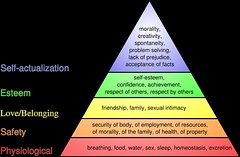
800px-Maslow's_hierarchy_of_needs.svg

Let’s talk about actualization, you and I. Take a good, strong look at where we stand.

Abraham Maslow, in 1943, a leader in humanistic psychology, came up with the theory of self-actualization.

No, this is no New Age nonsense: it’s not some Deepak Chopra chaff. It’s a theory that makes a lotta sense.


Maslow’s Hierarchy Of Needs is as follows:

a theory in psychology that Abraham Maslow proposed in his 1943 paper A Theory of Human Motivation, which he subsequently extended to include his observations of man’s innate curiosity. His theory contended that as humans meet ‘basic needs’, they seek to satisfy successively ‘higher needs’ that occupy a set hierarchy. Maslow studied exemplary people such as Albert Einstein, Jane Addams, Eleanor Roosevelt, and Frederick Douglass rather than mentally ill or neurotic people, writing that “the study of crippled, stunted, immature, and unhealthy specimens can yield only a cripple psychology and a cripple philosophy.”[1] Maslow also studied one percent of the healthiest college student population. While Maslow’s theory was regarded as an improvement over previous theories of personality and motivation, it had its detractors. For example, in their extensive review of research that is dependent on Maslow’s theory, Wabha and Bridwell (1976) found little evidence for the ranking of needs that Maslow described, or even for the existence of a definite hierarchy at all.


his description of the nature of self actualization. He's quoting an article on Answers.com Even though he basis his arugment upon Maslow he takes issue with Maslows ideas.

I disagree with this last sentence. We require our physical needs be met. We yearn for security, routine. As pack animals, we absolutely must be loved, and provided with a sense of belonging. From those three, flows the fourth. We are, after all, hierarchal creatures.

My addendum to this, is that the religious folks are pretty much stuck at the Esteem level.


As pack animals we must be loved? He's making leap into unsupported claims by implying that love is a need of pack animals. He makes the unsupported assertion that religious people are stuck in one of the phases. Of course he can't see atheists aer stuck just the rule keeping stage. This is a rank armature.I am betting he's in high school, it's certain he has not studied social sciences at the college level.

Now he's going in deeper, from supported claims to anecdotal evidence.


Let’s elaborate, with a personal anecdote. I had a pretty tough childhood (yeah, I know, we all did, just bear with me). Insecure, bullied, wrestling with the divergent hormone avalanche, I sought out alternative ways of validation. Food was one. The occult was another.

It gave me a secret, it gave me the illusion of power. Adolescent fantasies of strength. Luckily, I outgrew all that folderol.

And here is my take: there are many, many things in this life, this world, this universe, that are out of our individual control. Weather, other people’s behavior, other variables over which we exert zero control.


Of course if his low self esteem is what drove him to atheism, then we would search through a succession of positions that would grant him the best illusion of power and worth. It somehow just doesn't occur to him that since he hasn't gotten healed emotionally then the one stuck with is just the one that offers the greater illusion. So my theory about atheists is that they are into the hate because it give them the rush of feeling Superior. They can prop up their failing self esteem by saying "look at these stupid religious slobs, they are so much dumber than i am." One would never think that by reading he hateful intro to his blog above.


So it is in this cloak of flesh we wear, that insecurity plagues us, dogs our footsteps, and sends the wearer on various bunny trails.


Gnostic dualism yet?


So, of all the paths we tread, those that are most tempting, are the ones that are well trodden, that whisper of the ego of personal power. Whether it be of ourselves as the mighty warrior or the keeper of darkness, the vessel of some ghostly power that will act upon us or to impart some supernatural element in hopes that all will be made right one day, that keening wail of the down-trodden that someone comes someday to pass judgment so that the scales will be righted.

If we look at the fifth level, the formula comes clear: most atheists I know are in possession of those attributes (that I know of: there are exceptions, no doubt).

Atheism is what adults do, that is, when the bloom is off the adolescent rose.


It would be hilarious if it wasn't so sad. Let's talk about what adult don't do. First of all, if they have academic training at all, even at the undergraduate level, they don't' blather unsupported assertions and they try to support them with nothing more anecdotal evidence. This is nothing more than the atheist tendency to play social scientist which we see going awry in so many failed atheist arguments all over the net. This is about the worst one I've ever seen. Another thing adults don't do is mock, ridicule and deride people with other view points just becuase they differ from our own. The only reason this guy doesn't this is because he's not an adult he's probably a high school kid rebelling against Dad because because he's gotten a big does of super ego to counter his own id, and obviously he discovered some bits of psychoanalytic theory and he can resist trying to play shrink.

And so we as atheists go about, attempting to educate our fellow adults, who are trying to clutch the dreams of their youth with tremulous hands. It falls to us, then, to lead the world to maturity.

This is the
Apostate, signing off.


so that's what they are doing when they mock, deride, and ridicule me and claim I didn't go to graduate school and refuse to read the posts I spend hours researching, and tell me I have never read the books I've read. They are trying to educate me. In what? In anecdotal evidence?

To be an educator my deal little ignoramus you must know something! You do not know shit from shinola!

The fact of the matter is Maslow would have thought this approach imbecilic. Maslow, though an atheist, did not think religious people were fools. he said "atheists and believers can go a long way down the path together." He admired religious people adn thought they were strong. He admired because the research data that he did proved that people with religious experience re much more self actualized than those who don't have it.

I'll say it again. The studies show that people who have religious experience (what Mslow called "peak experience") other call "mystical," score much higher on self actualization tests than do atheists.

Maslow was concerned with showing healthy psychology. He noted that Freud,Jung, and all the major thinkers in the field of psychology focused on what makes people abnormal, they wanted to know what makes people healthy. His notion of self actualization is the idea, the epitome of healthy psychology. In his research Maslow discovered that religious people tended to be more self actualized than those who do not have religious experiences and he wrote a book about it: Religious Values and Peak Experience (the entire text of the book is on line).


studies have validated Maslow:


Journal of Humanistic Psychology, Vol. 22, No. 3, 92-108 (1982)
DOI: 10.1177/0022167882223011

Scale Development and Theory Testing

Eugene W. Mathes

Department of Psychology, Western Illinois University, Macomb, Illinois 61455.

The research reported here involved the creation of a measure of the tendency to have peak experiences called the Peak Scale, and the testing of several hypotheses drawn from Maslow's theory of peak experiences. It was found that although individuals who report having peak experiences are also likely to report having experiences involving intense happiness, they are even more prone to report having cognitive experiences of a transcendent and mystical nature. This suggests that although the peak experience involves positive affect, it is primarily a transcendent and mystical cognitive event. Individuals who report having peak experiences are more likely to report living in terms of Being-values, such as truth, beauty, and justice, than individuals who report not having peak experiences. Finally, self-actualizing individuals are more likely to report having peak experiences than less self-actualizing individuals, though the relationship is not a very strong one. In general, these results are consistent with Maslow's theorizing.


Many other studies have done as well.


Dr. Michale Nielson,Ph.D. Psychology and religion.
"http://www.psywww.com/psyrelig/ukraine/index.htm"

Quote:

"What makes someone psychologically healthy? This was the question that guided Maslow's work. He saw too much emphasis in psychology on negative behavior and thought, and wanted to supplant it with a psychology of mental health. To this end, he developed a hierarchy of needs, ranging from lower level physiological needs, through love and belonging, to self- actualization. Self-actualized people are those who have reached their potential for self-development. Maslow claimed that mystics are more likely to be self-actualized than are other people. Mystics also are more likely to have had "peak experiences," experiences in which the person feels a sense of ecstasy and oneness with the universe. Although his hierarchy of needs sounds appealing, researchers have had difficulty finding support for his theory."

Gagenback

Quote:

In terms of psychological correlates, well-being and happiness has been associated with mystical experiences,(Mathes, Zevon, Roter, Joerger, 1982; Hay & Morisy, 1978; Greeley, 1975; Alexander, Boyer, & Alexander, 1987) as well as self-actualization (Hood, 1977; Alexander, 1992). Regarding the latter, the developer of self-actualization believed that even one spontaneous peak or transcendental experience could promote self-actualization. Correlational research has supported this relationship. In a recent statistical meta-analysis of causal designs with Transcendental Meditation (TM) controlling for length of treatment and strength of study design, it was found that: TM enhances self-actualization on standard inventories significantly more than recent clinically devised relaxation/meditation procedures not explicitly directed toward transcendence [mystical experience] (p. 1; Alexander, 1992)


But let us turn to quotations by Maslow himself, becuase it's very instructive. Maslow was an atheist but the had Buddhist leanings and he did not hate religious people. He respected religious people, especially mystics. He said:

My feeling is that if it were never to happen again, the power of the experience could permanently affect the attitude toward life. A single glimpse of heaven is enough to confirm its existence even if it is never experienced again. It is my strong suspicion that even one such experience might be able to prevent suicide, for instance, and perhaps many varieties of slow self-destruction, e.g., alcoholism, drug-addiction, addiction to violence, etc. I would guess also, on theoretical grounds, that peak-experiences might very well abort "existential meaninglessness," states of valuelessness, etc., at least occasionally. (These deductions from the nature of intense peak-experiences are given some support by general experience with LSD and psilocybin. Of course these preliminary reports also await confirmation.

This then is one kind of peak-knowledge of whose validity and usefulness there can be no doubt, any more than there could be with discovering for the first time that the color "red" exists and is wonderful. Joy exists, can be experienced and feels very good indeed, and one can always hope that it will be experienced again.


and again:


Now that may be taken as a frank admission of a naturalistic psychological origin, except that it invovles a universal symbology which is not explicable through merely naturalistic means. How is it that all humans come to hold these same archetypical symbols? (For more on archetypes see Jesus Chrsit and Mythology page II) The "prematives" viewed and understood a sense of transformation which gave them an integration into the universe. This is crucial for human development. They sensed a power in the numenous, that is the origin of religion."

"In Appendix I and elsewhere in this essay, I have spoken of unitive perception, i.e., fusion of the B-realm with the D-realm, fusion of the eternal with the temporal, the sacred with the profane, etc. Someone has called this "the measureless gap between the poetic perception of reality and prosaic, unreal commonsense." Anyone who cannot perceive the sacred, the eternal, the symbolic, is simply blind to an aspect of reality, as I think I have amply demonstrated elsewhere (54), and in Appendix I, fromPeak Experience


Anyone who cannot perceive the sacred and the eternal is blind... does that sound like the adult Maslow is ready to join in with your friend in mocking and ridiculing religious thought?

The Greely study spcificially disproves the notion this guy sets forth that religious people are losers and unsuceesful and trying to pretend about a "sky daddy" becuase they can't make it in life:

Furthermore, Greeley found no evidence to support the orthodox belief that frequent mystic experiences or psychic experiences stem from deprivation or psychopathology. His ''mystics'' were generally better educated, more successful economically, and less racist, and they were rated substantially happier on measures of psychological well-being. (Charles T. Tart, Psi: Scientific Studies of the Psychic Realm, p. 19.)


Long term effects of religious experience have been demonstrated by such major studies as Noble and Wuthnow:

Long-Term Effects

Wuthnow:

*Say their lives are more meaningful,
*think about meaning and purpose
*Know what purpose of life is
Meditate more
*Score higher on self-rated personal talents and capabilities
*Less likely to value material possessions, high pay, job security, fame, and having lots of friends
*Greater value on work for social change, solving social problems, helping needy
*Reflective, inner-directed, self-aware, self-confident life style

Noble:

*Experience more productive of psychological health than illness
*Less authoritarian and dogmatic
*More assertive, imaginative, self-sufficient
*intelligent, relaxed
*High ego strength,
*relationships, symbolization, values,
*integration, allocentrism,
*psychological maturity,
*self-acceptance, self-worth,
*autonomy, authenticity, need for solitude,
*increased love and compassion

Short-Term Effects (usually people who did not previously know of these experiences)

*Experience temporarily disorienting, alarming, disruptive
*Likely changes in self and the world,
*space and time, emotional attitudes, cognitive styles, personalities, doubt sanity and reluctance to communicate, feel ordinary language is inadequate

*Some individuals report psychic capacities and visionary experience destabilizing relationships with family and friends Withdrawal, isolation, confusion, insecurity, self-doubt, depression, anxiety, panic, restlessness, grandiose religious delusions

Links to Maslow's Needs, Mental Health, and Peak Experiences When introducing entheogens to people, I find it's helpful to link them to other ideas people are familiar with. Here are three useful quotations. 1) Maslow - Beyond Self Actualization is Self Transcendence ``I should say that I consider Humanistic, Third Force Psychology to be transitional, a preparation for a still `higher' Fourth Psychology, transhuman, centered in the cosmos rather than in human needs and interest, going beyond humanness, identity, selfactualization and the like.''

Abraham Maslow (1968). Toward a Psychology of Being, Second edition, -- pages iii-iv.


2) States of consciousness and mystical experiences
The ego has problems:
the ego is a problem.

``Within the Western model we recognize and define psychosis as a suboptimal state of consciousness that views reality in a distorted way and does not recognize that distortion. It is therefore important to note that from the mystical perspective our usual state fits all the criteria of psychosis, being suboptimal, having a distorted view of reality, yet not recognizing that distortion. Indeed from the ultimate mystical perspective, psychosis can be defined as being trapped in, or attached to, any one state of consciousness, each of which by itself is necessarily limited and only relatively real.'' -- page 665


Roger Walsh (1980). The consciousness disciplines and the behavioral sciences: Questions of comparison and assessment. American Journal of Psychiatry, 137(6), 663-673.


3) Therapeutic effects of peak experiences

``It is assumed that if, as is often said, one traumatic event can shape a life, one therapeutic event can reshape it. Psychedelic therapy has an analogue in Abraham Maslow's idea of the peak experience. The drug taker feels somehow allied to or merged with a higher power; he becomes convinced the self is part of a much larger pattern, and the sense of cleansing, release, and joy makes old woes seem trivial.'' -- page 132


Lester Grinspoon and James Bakalar (1983). ``Psychedelic Drugs in Psychiatry'' in Psychedelic Drugs Reconsidered, New York: Basic Books.


Transpersonal Childhood Experiences of Higher States of Consciousness: Literature Review and Theoretical Integration. Unpublished paper by Jayne Gackenback, (1992)
http://www.sawka.com/spiritwatch/cehsc/ipure.htm

"These states of being also result in behavioral and health changes. Ludwig (1985) found that 14% of people claiming spontaneous remission from alcoholism was due to mystical experiences while Richards (1978) found with cancer patients treated in a hallucinogenic drug-assisted therapy who reported mystical experiences improved significantly more on a measure of self-actualization than those who also had the drug but did not have a mystical experience. In terms of the Vedic Psychology group they report a wide range of positive behavioral results from the practice of meditation and as outlined above go to great pains to show that it is the transcendence aspect of that practice that is primarily responsible for the changes. Thus improved performance in many areas of society have been reported including education and business as well as personal health states (reviewed and summarized in Alexander et al., 1990). Specifically, the Vedic Psychology group have found that mystical experiences were associated with "refined sensory threshold and enhanced mind-body coordination (p. 115; Alexander et al., 1987)."


(4) Greater happiness


Religion and Happiness

by Michael E. Nielsen, PhD


Many people expect religion to bring them happiness. Does this actually seem to be the case? Are religious people happier than nonreligious people? And if so, why might this be?

Researchers have been intrigued by such questions. Most studies have simply asked people how happy they are, although studies also may use scales that try to measure happiness more subtly than that. In general, researchers who have a large sample of people in their study tend to limit their measurement of happiness to just one or two questions, and researchers who have fewer numbers of people use several items or scales to measure happiness.

What do they find? In a nutshell, they find that people who are involved in religion also report greater levels of happiness than do those who are not religious. For example, one study involved over 160,000 people in Europe. Among weekly churchgoers, 85% reported being "very satisfied" with life, but this number reduced to 77% among those who never went to church (Inglehart, 1990). This kind of pattern is typical -- religious involvement is associated with modest increases in happiness


Argyle, M., and Hills, P. (2000). Religious experiences and their relations with happiness and personality. The International Journal for the Psychology of Religion, 10, 157-172.

Inglehart, R. (1990). Culture shift in advanced industrial society. Princeton, NJ: Princeton University Press.

< face="Arial Narrow">
Recent Empirical Studies Prove Religious Believers have less depression, mental illness lower Divorce rate, ect.


J. Gartner, D.B. Allen, The Faith Factor: An Annotated Bibliography of Systematic Reviews And Clinical Research on Spiritual Subjects Vol. II, David B. Larson M.D., Natiional Institute for Health Research Dec. 1993, p. 3090

Quote:

"The Reviews identified 10 areas of clinical staus in whihc research has demonstrated benefits of religious commitment: (1) Depression, (2) Suicide, (3) Delinquency, (4) Mortality, (5) Alchohol use (6) Drug use, (7) Well-being, (8) Divorce and martital satisfaction, (9) Physical Health Status, and (10) Mental health outcome studies....The authors underscored the need for additional longitudinal studies featuring health outcomes. Although there were few, such studies tended to show mental health benefit. Similarly, in the case of teh few longevity or mortality outcome studies, the benefit was in favor of those who attended chruch...at least 70% of the time, increased religious commitment was associated with improved coping and protection from problems."

[The authors conducted a literature search of over 2000 publications to glean the current state of empirical study data in areas of Spirituality and health]
70% of the time believers are more likely than non believers (or at least experiences are more likely than non experiencers) to have these effects of self actualization.