Showing posts with label Abraham Maslow. Show all posts

Monday, May 7, 2012

Why Atheists Have No Ears

 Photobucket


Apologetics is not for unbelievers. It's not exactly for convincing oneself either, but it is definitely not for atheists. Its' pointless trying to convince someone of something that is contrary to their paradigm. Paradigms control all. People  are not capable of seeing into a different world. They live in the world they are in, the world of the paradigm. Paradigm shifts only happen when there are too many anomalies to be absorbed by the old paradigm. Until that happens there's no convincing someone his paradigm is wrong. Now you might think this means that we should go about the task of trying pile up anomalies. The problem with that is atheists are able to absorb vast amounts of anomalies into their paradigm and they employ a verity of methods to do so. Kuhn says this is what happens, the ruling paradigm can adsorb a certain degree of anomalies and until you get so many that the paradigm can't deal with them any more and the paradigm starts to shift, they are just all absorbed and don't' seem to matter.

Now I think little by little the paradigm is shifting, it will eventually turn over. It will probably never be non-materialists or "spiritualist." But it is clear that the old paradigm has given way in several areas and ideas that would once have been considered totally loony are now part of the new paradigm. The problem is the new paradigm is packaged as a continuation of the old; in other words, the old materialist paradigm has now given way to the new physicalist. The difference being that under the old paradigm (materialist) only materiel things were possible. Reality was thought of as the "material" realm. Then it was realized that energy is another form of matter, so it's not mater itself and thus more than just mater is possible.So the new paradigm (phsyicalist) says that only what is physical is possible. Spirit still ruled out (except it can come in the back door in the form of energy) but it is recognized that there are two media for existence, rather than just the material there is also energy (which is another form of matter).

Meanwhile, there are many areas through which the evil idealism has seeped into the new paradigm: healing in medicine, the idea of mind over matter, realms beyond that of nature (which is what string membranes are) but they have to be packed as "physical." As long as it all part of "the physical" (which is idealist enough as it goes, then it can have a place. So ideas which never have been considered fifty years ago are now front and center. But the only proviso is we can't acknowledge it. We have to keep up the charade that idealism/spiritualism is beaten and materialism (in the form of physicalism which allows for energy) prevails. But in prevailing it makes room for other realms beyond that of nature (space/time) mind over matter, healing in medicine, archetypes, here's a complete list:

(1) Quantum Theory (no need for cause/effect)

(2) Big bang Cosmology (realm beyond the natrual)

(3) Medicine (healing)

(4) Consciousness (invites concept of dualism)

(6) Maslow's Archetypes (universal ideas)

(7) Miracles (empirical evidence)

(8) Near Death Experiences (scientific evidence)

(9) Esp Research (the fact that they do it)

(10) Validity of religious experince (Shrinks no longer assume pathology)

(11) Mind over matter (pleacebo effect).


For this reason I am willing to think that the paradigm will eventually shift. It probably wont ever allow for "supernatural," but it will contain supernatural-like ideas masquerading as materialist/physicialist. We already see it now in the mind over matter of the placebo effect.

Nevertheless, despite this movement, the materialist/physicalist paradigm can absorb an almost infinite amount things that are anomalous in thier behavior simply because "energy" covers a multitude of idealist propositions. Anything not material can always be sold as "energy." Pure idea can be sold as brain chemistry because it has to be transmitted that way. Thus Dawkins insists there cant' be a mind without a brain. But what's really being said there is that any form of ideal or idea or "mind" or anything not material can always be coopted as "energy" and thus it can never be anomalous under a physicalist paradigm. But there's another reason as well why it will take a long time for a big paradigm shift. There is no end of atheist incredulity. The physicalist paradigm lends itself to incredulity because we know it works. We don't know the range of its limitations because we can't produce evidence under the same paradigm of things beyond the paradigm, so of course we can exclude any hint of actual anomaly. Of course we can't expect evidence under the paradigm that would legitimate anomalies of that same paradigm, then they wouldn't be anomalies. The incredulity factor always allows one to put it in the magic pressure cooker and (whish wish) it's gone!

Here's an example of what I mean. Here's an example of a Saint making miracle from my miracles page. It's no longer found on the URL it once was, so the link doesn't work. But it was there:


Society for the Little Flower (Website) FAQ (visited 6/3/01) St. Theresse of Lisieux

http://www.littleflower.org/therese/faq.html#4

"Regarding St. Therese, in 1923 the Church approved of two spontaneous cures unexplained by medical treatment. Sister Louise of St. Germain was cured of the stomach ulcers she had between 1913 and 1916. The second cure involved Charles Anne, a 23 year old seminarian who was dying from advanced pulmonary tuberculosis. The night he thought he was dying, Charles prayed to Therese. Afterward, the examining doctor testified, "The destroyed and ravaged lungs had been replaced by new lungs, carrying out their normal functions and about to revive the entire organism. A slight emaciation persists, which will disappear within a few days under a regularly assimilated diet." These two miracles resulted in Therese becoming beatified."


The atheists on carm treated this with total incredulity. It has to be a lie. First they said I made it up. then I linked to the site and they could see it was their and howled with laughter. How stupid could I be? It's a religious site dedicated to that saint to of course it's a lie! I gave all the evidence on miracles pages about the rules of miracles in RCC and showed that they use medical evdience, there x-rays of the lungs and so on. But they insisted this is not good because its not in a medical journal. So I emailed a member of the committee, a medical expert who does research for the medical committee, and he vouched for its authenticity. That's no good, he' on that committee so he's lying. I brought up the x-rays, well I don't have the x-rays so its' still lie. I would have to have the x-rays in my hot little hand before it could actually be accepted. If i actually get the xrays from the Vatican, which were taken in the early part of the 20th century, (like that's a fair requirement that I some little guy in Texas, a prot, with no official connections could get these xrays), if I did have them don't you think they would still say its a lie? x-rays can be fabricated. So it's an anomaly and it will always be an anomaly because one may always doubt.

I recently had a discussion on my message boards about my mystical experience arguments (The Trace of God). I was as clear as anyone could be, and i worked several times to meet the evidential burden required by the atheist dialogue "partner." But this guy just played dense. He refused to get it. But I think a Chrsitain poster named "Wordgazer" really summed it up best:


FWIW, I didn't have any trouble following or understanding Metacrock's reasoning, and I do think he addressed each of Marxiavelli's concerns. What it looked like to me was that Marxiavelli was looking at things through his scientific materialist worldview, and was either unable or unwilling to shift to a different perspective. For example, he seemed to think Metacrock was using the religious experience argument to prove one particular set of religious beliefs, and because they didn't do this, Marxiavelli appeared to think that this trumped all rational warrant for a belief in anything non-material at all. But Metacrock was not arguing for Christianity; he was arguing for the interaction between humans and something Divine that was undefined. What I was seeing was something that I myself have experienced-- the challenge by an atheist to prove theism, but only within the atheism box. Invitations to climb out of the box and look further, were apparently misunderstood as not answering the questions. There were a few times that Metacrock got frustrated, but I really don't think he was being "extremely and unnecessarily aggressive."


We live in different worlds. The world of the atheist is not the world of the theist and they don't want to see into my world. They want to reassure themselves that it's ok to deny my world is valid and to secure their own world. One can hide a lot of anomalies that way. As Wordgazer said it's really just a matter of who wants to see what. Of course they would impune my motives for wanting to see the validity of my world, but pat themselves on the back and rationalize their biases as "hard nosed critical thinking." Hard nosed critical thinking that does not want to see.

This is why the realizing God (existential phenomenological who ha) is really the only tenable approach. Until one is willing make a realization, or until one does make such a realization, the anomalies will always be absorbed into he paradigm. "Realizing God" is nothing more than a change in the ground, a shift in consciousness, a paradigm shift. The materialist paradigm is front end loaded with built-in incredulity as a defense mechanism against shifts.

But all of this really biols down to is good old fashioned sin. "5 And the light shineth in darkness; and the darkness comprehended it not." (John 1:5). No amount of evdience will ever shit them and no amount of logic will ever read them.

Now this doesn't mean that I wont continue the friendships I've made. I have made freinds with some atheists, and some who are good people who I really like. I will continue those friendships and we can discuss anything. But I wont discuss God with them or God arguments. There's no point. The literal reading of the "great commission" (the Bible doesn't call it that) says "where ever you happen to be going, tell them the truth." I did tell them. They didn't want to get it.

Friday, June 10, 2011

Another Nail in the Coffin of The CARM Atheists Medacity about my Studies Validating My Experince of God Arguments

Photobucket


This is a post in the thread on bait and switch, by Mary Jane.

http://forums.carm.org/vbb/showthread.php?57332-atheist-bait-and-switch&p=1730779#poststop

I have a huge body of scientific work that validats my experince of God arguments. CARM atheists have done everything they could think of to discredit, obfuscate, and ignore that body of work except actually read some and argue fierily about it. I put up a link to a book chapter over 147 times two people read it and one claimed he didn't understand it the other attacked something in it that the author was attacking to, only the atheist thought he was beating up on the author.


This is another pointless claim by MJ to create the impression that she's read the studies that I talk about. Again, she has not read them. All she's doing is confusing a summary article by Mohan with a study. There is a Mohan study, but she hasn't read it. What she read was an article by Mohan that is not a study. By this she actually twisted all the statements around on the assumption that i have to be wrong so what I say is false so they must mean the opposite.

On that premise she just goes wild trying to create impressions that have no bearing on reality.
Originally Posted by Metacrock View Post
the 200 studies that none of your will read, and that you can't come to grips with totally blow your position away.

They establish the co-determinate of God on the same kind of grounds that you establish any scientific fact.


LOL. Except a lot of us HAVE READ THEM and our positions remain entirely unblown.
what she points to here is nothing but a discussion about the summary article that is not a study. This is does nothign to prove that she read a study. Besides that he's acting so triumphant about reading a study (which she did not do) one study! there 199 more to go that she clearly hasn't read (if she read one).

Perhaps we can tackle this again, since you didn't answer the last time.
Ok. Let's get this cleared up once and for all.

The 200 studies that Meta likes to mention all the time and bring up in every thread, no matter what the subject is, are as follows:
Yea lets do take the opportunity to clear things up.


MJ:
134 'studies' is a reference list (bibliography) copied from an article by Mohan on the use of spirituality in counselling. There are very few actual studies in that bibliography.
Factual error 1: I never said there were 134 studies on the bib to the Mohan article (she admits here the Mohan reading is an article). I used the Bible as a partial list of studies because there are many on it. I never claimed a number nor did I ever claim that it was a major list.

Factual Error 2: the statement that there aer few studies is totally untrue and totally at odds with the fact. Most of the entries in the bib are studies.

Factual Error 3: She is confused about the nature of the list because there is no one source published that contains all the studies I speak of when I say "200." That figure is my own form my bib in my book that's not out yet. I use a a couple of the bibs from articles as references because they contain several of the studies. I never said the whole is compiled from just Mohan.


MJ
It is mostly populated by articles, reviews and religious texts. The list can be found here. Meta, of course, still includes these references in his list of 200 studies and accuses me of 'nitpicking' when I point out that they're not.
This is total confusion on her part. it's true the Mohan article is an article so it has reference to many kinds of literature. I never claimed the Mohan article bib is the basis of my list of 200. It contains many of them (not 134 I don't think) but they also come from any other source,s bibs and other things I've read (as any researcher will d0). The link she lists there is my source on Athistwatch and it's just the Mohan bib. I put it there for reference so that people have something to consult when they want some sources on the topic. It is a really good bib.


MJ
It's easy claim that you've got 200 empriical studies when you redifine empirical study to include religious texts, articles and reviews. There's also a question of how relevant the very few studies are to his claim, as he won't explain what he's trying to prove with those studies.
Here we have another statement at variance with truth. The allegation that I redefine "empirical study" to include religious texts" is a bit of mendacity that is calculated and absurd. It's based upon untruth, certainly not upon any claim I made. I have said in the post nothign more than the fact that the all the 200 are peer retrieved academic studies in academic journals. I think we see here who really understands what a study is and what it's not. I was a sociology major in undergraduate school. I conducted a study for class in my sophomore year when I took a graduate level class on research methods in sociology. I was a college debater, in the 1970s. That meant reading hundreds of studies over the course of one year, every year for all four years of college. In NDT style policy debate f that time one either learned to cope with study methodology or one never won any debates.

moreover, there are no religious texts on many of the bibs I use, I think she got that becasue some of the studies involve TM. She confusing TM with a religious text. Who knows, who knows where people get these things. I think if I recall there was a source on the bib that seemed to written by a swami or something, but it wasn't part of the 200 it was just on Mohan's bib. She's assuming that Mohan's Bib is like 90% of my studies and it's no where near the case.


MJ
Then there are studies done by Wuthnow and Noble on the long term positive effects of mystical experience. They found that those who had such an experience were more self-actualized then they were before. The study doesn't say where the experience comes from or how those who've had it fare against those who have not.
here we have two distinct falsehoods, lets break them down and answer them one at a time:

(1) doesn't say where the experiences came from.

this false impression has been attempted many times by atheists on carm. The fallacy that a scientific study has to speculate about the existence of God or it's not proof of the value of the experience. That's just bilge water because it doesn't make any sense, it's a contradiction to the very concept of study design (since you can't design a study for the transcendent) you can't expect scientist to speak outside their domain. Hood says in his text book this very thing "It is not our place as scientist to assumptions about the existence of God." That's a close paraphrase.
That argument is null and void anyway becuase the result of the experiences and their context are two of the major reasons to attribute it to the divine, you don't need some guy in a white lab coat to say "yea that's really God." The individual logician should be angel to handle any logical inference without appeal to authority to tell him/her how to think. This is one of the few things the atheist gang on carm actually has to argue agaisnt the studies. So it has become a mantra.

(2)how those who've had it fare against those who have not.

yes it does say that, he does compare. This is a proof that she hasn't read Wuthnow. There's no way one could mistake this. If you read the study you see table after table where the comparisons are made. Very First page of the article, page 59, first line of the sumary:

This article presents evidence from a random sample of the San Fransisco Bay Area on some of the difference bewteen people who claim to have had intense peak experience and people who have not had such experiences!"
Obviously this is a comparison between two groups, experiences and on experiences. If she read the study why didn't she see that? Moreover, in the table on 66, it speaks of the categories in which the people are put and they comprise: response to peack experience item yes within one year (had the experience) yes but not in a year, yes but not lasing, no but would like to, no but would not care to. on 67 there's a table comparing "high peakers," "average peakers" and "non speakers." That's obviously a comparsion between those who have and those who have not had the experience. On 68 a reference to a table with the same distinctions. agan on 69, 70, 72, 73.

how could anyone read the study and miss this stuff?

on 65 he says "the data indicates that the peackers do differ on these kinds of questions from non peakers." Obviously then they are comparing those who have the experience with those who do not.

btw on one measure, "life is very meaningful" there's a 30% difference between high peakers and non peaksers for finding life meaningful with 68% of high peakers finding it very meaningful and 35% of non peakers finding it so.


MJ
They are not more self-actualized then those who haven't had an experience; they are more self-actualized THEN THEY WERE BEFORE THE EXPERIENCE.
6/10/11 Mary Jane
http://forums.carm.org/vbb/showthread.php?57332-atheist-bait-and-switch&p=1730779#poststop
clearly we have seen this is not the case in Wuthnow's study. If it was that would not be a bad study result becasue it's obviously relevant that one improves after the experience; that's the whole idea. It's not the case that they only comapred peakers to themselves as I just demonstrated Wuthnow compares both to each other.

the link that she links to is her own post on carm where asserts with with no backing.

MJ
Then there's Maslow's 'peak experience' that has nothing to do with anything religious or mystical - shown by a study with a 1000 participants in San Diego (some were atheists who've had these 'peak experiences').

This is a major distortion of the facts and misconception. It only demonstrates that she has not read the literature, especial not Maslow. She's confused about what Maslow was doing. He himself was an atheist that doesn't mean that he had the kind of snide religion hater attitude that many "new atheists" do today. He was one of the greatest social scientists of the 20th century and he knew enough to keep his feeilngs away from his data. that peak is a euphemism for mystical one can gleam immediately from reading the book. He was including religous experinces and in fact he knew that the vast majority of peakers were religious. He said "the atheist and the believer can do quite a long way together down the path (of mystical experience) before they must final separate." He knew he was including both.

the concept that an atheist and a Christian can both have these kinds of experiences and one cal it "God" and the other call it "nothing" is not amazing nor does it contradict theology or my argument. Vedantists (type of Hindu) experience god as a void. They believe in God and they are not atheists but they experience God the very same way atheists experience mystical reality, as a great void rather than a personality. Since the experience is beyond word, thought, or image, one must filter it through culture to talk about it, then it only makes sense that some have the capacity if they so pre disposed to deny that it's connected to "God." What they don't deny is that it's connected to the ground of being or ultimate reality.

The experiences can be interpreted in terms of anyone's doctrine, that's why doctrine is not really very important. What's important is expernice, and that's what the athist here are denying, an experience they have never had (perhaps some have).

Maslow said: "Anyone who cannot perceive the sacred, the eternal, the symbolic, is simply blind to an aspect of reality, as I think I have amply demonstrated elsewhere (54), and in Appendix I, fromPeak Experience" He's obviously including the mystical in with the peack experience since he sees it as "the sacred."

Here's a link to an online copy of his book on peak experience.

http://www.druglibrary.org/schaffer/lsd/maslow.htm


From that point we have to get into specific arguemnts the way I make them and that's for latter. We must bracket that, but the fact is she does not have an argument here by pointing out that a tiny percent of peakers are atheists.

MJ
I should add that I was taught in University that Maslow's ideas of self-actualization have fallen out of favor due to a lack of empirical support. More on that here if you're willing to read a whole book.


(1) That concerns the hierarchy of needs ont the peak studies
(2) Maslows research on peak was good but outdated by others who still hold his position
(3) his assertions about peak have been validated up tot he present
(4) He still has a discipline that he started himself and a discipline of supporters
(5) He's still revered as a classic

that is not a methodological incitement. It's also anecdotal because she has no studies to back it up. She has no source to back it up. I do. It says nothing about the validity of his studies. It's nothing ore than a political statement. The climate of pinon disfavors anything that doesn't load patents up with drugs and explain everything through chemicals but the discipline that Maslow began still has his supporters and his major preemies are still proved by many studies. That's talking about his hierarcy of needs not this studies on peak experince. Besides his studies were done in the late 60's and ealry 70s before even Muthnow and Nobel. His work became outdated with theirs. It was good gut it wasn't enough, they went further. The theory on hierarchy of needs has nothing to do with peak experince.

http://www.nwlink.com/~donclark/leader/leadhb.html

"Maslow's theory remains a classic because rather than looking at psychology as strictly the study of the mentally ill, his theory was based upon healthy persons. And being one of the first humanistic ones, it has its share of flaws. "

MJ
Then there's the M-scale which, as I understand it, is used to measure the likeness of mystical experience cross-culturally. Basically, mystics in Sweden experience similar mystical experiences to mystics in India. That says a lot about human nature and thought processes, but nothing about the source of that experience.
this is a half backed understanding of it but it's not so far wrong that we can just let that go. The sloughing it off as human nature will not do. This is another CARM atheistism which is somethign the pulled out of a hat because they couldn't answer the research. They have to explain it somehow so they just ascribe it to human nature. If that were the case why don't all people have peack experience and get better? Moreover, the real issue is that the studies on the M scale found that throughout cultures around the world all the mystics are having the same experience. The attribute it to their own individual doctrines but when you remove the doctrinal terms and names they all read the same.

In other words if you compare muslim, Christian, Bhuddist, atheist, mystics and take out references to "Jesus," "Alah," Buddha," "the void" and just make it generic "undifferentiated univerity, pervasive presence of love" then they all read the same.

That's not really possible. Any vaild theory of psychology would have to tell us that such constructs are from culture. Innate ideas are not accepted in moedrn world. Innate ideas prove God a priori. You do't want this to be innate ideas of God if you are an atheist but that's what we are looking at becuase otherwise it has to be culture. If it's culture than that is totally unexplained because it can't be just the result of similarities in the mind. If there were true then why are languages different? why are cutlers different?

there are some similarities that result form just being human such as mothers love their babies and babies bond with the mother first. That's very different than a undifferentiated unity of all things appearing to someone in an experience of the world, and a overwhelming pervasive presence of love. Those clearly are not explained by the similarities of the human mind becuase we don't all have them.


Am I missing something Meta? Where's the other 50+ studies?


yes you missing a lot kido, But your basic false assumption is to think that Mohan's bib and my list are the same thing they are not. The 200 figure is ball park. Besides the bib for my book has about 150 but the rest of them are on Hood's Vita. He has done about 50-100 studies on this.

Monday, August 24, 2009

Who is Really Self Actuzliaed, Atheists or Theists?

Photobucket


Yeat another example of atheist attempt at social sciences, on the blog: God is for suckers

An atheist on the blog linked above discovered that actual sercet to realising the reality of God and he's too ignorant and vein to even figure what it means. He's trying to prove that Atheists are self actualized nd religious people not. In fact the studies actually, including those by Maslow whom he quotes and lauds, quite the opposite. Studies show that religious people are self actualized and atheists are not. But this guy, can't find his name, doesn't have a clue. So he uses anecdotal evidence and just asserts "all the atheists I nkow are like this so they must be self actualized, I hate Christianity so it must not be."


Here is how this advanced self actuzed enlightened human describes his site:


Commentary, news, and rants on the evils and stupidity of belief in the big invisible daddy in the sky. Illuminating and watchdogging the widespread attempts to institutionalize the theocratic rule of the US. Making fun of believers everywhere.


The graphic is from his blog

Now he's going to tell us what self actually is:

Atheism As Self Actualization

12 August 2007 by KA

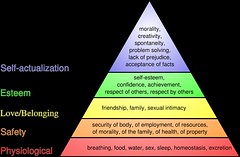
800px-Maslow's_hierarchy_of_needs.svg

Let’s talk about actualization, you and I. Take a good, strong look at where we stand.

Abraham Maslow, in 1943, a leader in humanistic psychology, came up with the theory of self-actualization.

No, this is no New Age nonsense: it’s not some Deepak Chopra chaff. It’s a theory that makes a lotta sense.


Maslow’s Hierarchy Of Needs is as follows:

a theory in psychology that Abraham Maslow proposed in his 1943 paper A Theory of Human Motivation, which he subsequently extended to include his observations of man’s innate curiosity. His theory contended that as humans meet ‘basic needs’, they seek to satisfy successively ‘higher needs’ that occupy a set hierarchy. Maslow studied exemplary people such as Albert Einstein, Jane Addams, Eleanor Roosevelt, and Frederick Douglass rather than mentally ill or neurotic people, writing that “the study of crippled, stunted, immature, and unhealthy specimens can yield only a cripple psychology and a cripple philosophy.”[1] Maslow also studied one percent of the healthiest college student population. While Maslow’s theory was regarded as an improvement over previous theories of personality and motivation, it had its detractors. For example, in their extensive review of research that is dependent on Maslow’s theory, Wabha and Bridwell (1976) found little evidence for the ranking of needs that Maslow described, or even for the existence of a definite hierarchy at all.


his description of the nature of self actualization. He's quoting an article on Answers.com Even though he basis his arugment upon Maslow he takes issue with Maslows ideas.

I disagree with this last sentence. We require our physical needs be met. We yearn for security, routine. As pack animals, we absolutely must be loved, and provided with a sense of belonging. From those three, flows the fourth. We are, after all, hierarchal creatures.

My addendum to this, is that the religious folks are pretty much stuck at the Esteem level.


As pack animals we must be loved? He's making leap into unsupported claims by implying that love is a need of pack animals. He makes the unsupported assertion that religious people are stuck in one of the phases. Of course he can't see atheists aer stuck just the rule keeping stage. This is a rank armature.I am betting he's in high school, it's certain he has not studied social sciences at the college level.

Now he's going in deeper, from supported claims to anecdotal evidence.


Let’s elaborate, with a personal anecdote. I had a pretty tough childhood (yeah, I know, we all did, just bear with me). Insecure, bullied, wrestling with the divergent hormone avalanche, I sought out alternative ways of validation. Food was one. The occult was another.

It gave me a secret, it gave me the illusion of power. Adolescent fantasies of strength. Luckily, I outgrew all that folderol.

And here is my take: there are many, many things in this life, this world, this universe, that are out of our individual control. Weather, other people’s behavior, other variables over which we exert zero control.


Of course if his low self esteem is what drove him to atheism, then we would search through a succession of positions that would grant him the best illusion of power and worth. It somehow just doesn't occur to him that since he hasn't gotten healed emotionally then the one stuck with is just the one that offers the greater illusion. So my theory about atheists is that they are into the hate because it give them the rush of feeling Superior. They can prop up their failing self esteem by saying "look at these stupid religious slobs, they are so much dumber than i am." One would never think that by reading he hateful intro to his blog above.


So it is in this cloak of flesh we wear, that insecurity plagues us, dogs our footsteps, and sends the wearer on various bunny trails.


Gnostic dualism yet?


So, of all the paths we tread, those that are most tempting, are the ones that are well trodden, that whisper of the ego of personal power. Whether it be of ourselves as the mighty warrior or the keeper of darkness, the vessel of some ghostly power that will act upon us or to impart some supernatural element in hopes that all will be made right one day, that keening wail of the down-trodden that someone comes someday to pass judgment so that the scales will be righted.

If we look at the fifth level, the formula comes clear: most atheists I know are in possession of those attributes (that I know of: there are exceptions, no doubt).

Atheism is what adults do, that is, when the bloom is off the adolescent rose.


It would be hilarious if it wasn't so sad. Let's talk about what adult don't do. First of all, if they have academic training at all, even at the undergraduate level, they don't' blather unsupported assertions and they try to support them with nothing more anecdotal evidence. This is nothing more than the atheist tendency to play social scientist which we see going awry in so many failed atheist arguments all over the net. This is about the worst one I've ever seen. Another thing adults don't do is mock, ridicule and deride people with other view points just becuase they differ from our own. The only reason this guy doesn't this is because he's not an adult he's probably a high school kid rebelling against Dad because because he's gotten a big does of super ego to counter his own id, and obviously he discovered some bits of psychoanalytic theory and he can resist trying to play shrink.

And so we as atheists go about, attempting to educate our fellow adults, who are trying to clutch the dreams of their youth with tremulous hands. It falls to us, then, to lead the world to maturity.

This is the
Apostate, signing off.


so that's what they are doing when they mock, deride, and ridicule me and claim I didn't go to graduate school and refuse to read the posts I spend hours researching, and tell me I have never read the books I've read. They are trying to educate me. In what? In anecdotal evidence?

To be an educator my deal little ignoramus you must know something! You do not know shit from shinola!

The fact of the matter is Maslow would have thought this approach imbecilic. Maslow, though an atheist, did not think religious people were fools. he said "atheists and believers can go a long way down the path together." He admired religious people adn thought they were strong. He admired because the research data that he did proved that people with religious experience re much more self actualized than those who don't have it.

I'll say it again. The studies show that people who have religious experience (what Mslow called "peak experience") other call "mystical," score much higher on self actualization tests than do atheists.

Maslow was concerned with showing healthy psychology. He noted that Freud,Jung, and all the major thinkers in the field of psychology focused on what makes people abnormal, they wanted to know what makes people healthy. His notion of self actualization is the idea, the epitome of healthy psychology. In his research Maslow discovered that religious people tended to be more self actualized than those who do not have religious experiences and he wrote a book about it: Religious Values and Peak Experience (the entire text of the book is on line).


studies have validated Maslow:


Journal of Humanistic Psychology, Vol. 22, No. 3, 92-108 (1982)
DOI: 10.1177/0022167882223011

Scale Development and Theory Testing

Eugene W. Mathes

Department of Psychology, Western Illinois University, Macomb, Illinois 61455.

The research reported here involved the creation of a measure of the tendency to have peak experiences called the Peak Scale, and the testing of several hypotheses drawn from Maslow's theory of peak experiences. It was found that although individuals who report having peak experiences are also likely to report having experiences involving intense happiness, they are even more prone to report having cognitive experiences of a transcendent and mystical nature. This suggests that although the peak experience involves positive affect, it is primarily a transcendent and mystical cognitive event. Individuals who report having peak experiences are more likely to report living in terms of Being-values, such as truth, beauty, and justice, than individuals who report not having peak experiences. Finally, self-actualizing individuals are more likely to report having peak experiences than less self-actualizing individuals, though the relationship is not a very strong one. In general, these results are consistent with Maslow's theorizing.


Many other studies have done as well.


Dr. Michale Nielson,Ph.D. Psychology and religion.
"http://www.psywww.com/psyrelig/ukraine/index.htm"

Quote:

"What makes someone psychologically healthy? This was the question that guided Maslow's work. He saw too much emphasis in psychology on negative behavior and thought, and wanted to supplant it with a psychology of mental health. To this end, he developed a hierarchy of needs, ranging from lower level physiological needs, through love and belonging, to self- actualization. Self-actualized people are those who have reached their potential for self-development. Maslow claimed that mystics are more likely to be self-actualized than are other people. Mystics also are more likely to have had "peak experiences," experiences in which the person feels a sense of ecstasy and oneness with the universe. Although his hierarchy of needs sounds appealing, researchers have had difficulty finding support for his theory."

Gagenback

Quote:

In terms of psychological correlates, well-being and happiness has been associated with mystical experiences,(Mathes, Zevon, Roter, Joerger, 1982; Hay & Morisy, 1978; Greeley, 1975; Alexander, Boyer, & Alexander, 1987) as well as self-actualization (Hood, 1977; Alexander, 1992). Regarding the latter, the developer of self-actualization believed that even one spontaneous peak or transcendental experience could promote self-actualization. Correlational research has supported this relationship. In a recent statistical meta-analysis of causal designs with Transcendental Meditation (TM) controlling for length of treatment and strength of study design, it was found that: TM enhances self-actualization on standard inventories significantly more than recent clinically devised relaxation/meditation procedures not explicitly directed toward transcendence [mystical experience] (p. 1; Alexander, 1992)


But let us turn to quotations by Maslow himself, becuase it's very instructive. Maslow was an atheist but the had Buddhist leanings and he did not hate religious people. He respected religious people, especially mystics. He said:

My feeling is that if it were never to happen again, the power of the experience could permanently affect the attitude toward life. A single glimpse of heaven is enough to confirm its existence even if it is never experienced again. It is my strong suspicion that even one such experience might be able to prevent suicide, for instance, and perhaps many varieties of slow self-destruction, e.g., alcoholism, drug-addiction, addiction to violence, etc. I would guess also, on theoretical grounds, that peak-experiences might very well abort "existential meaninglessness," states of valuelessness, etc., at least occasionally. (These deductions from the nature of intense peak-experiences are given some support by general experience with LSD and psilocybin. Of course these preliminary reports also await confirmation.

This then is one kind of peak-knowledge of whose validity and usefulness there can be no doubt, any more than there could be with discovering for the first time that the color "red" exists and is wonderful. Joy exists, can be experienced and feels very good indeed, and one can always hope that it will be experienced again.


and again:


Now that may be taken as a frank admission of a naturalistic psychological origin, except that it invovles a universal symbology which is not explicable through merely naturalistic means. How is it that all humans come to hold these same archetypical symbols? (For more on archetypes see Jesus Chrsit and Mythology page II) The "prematives" viewed and understood a sense of transformation which gave them an integration into the universe. This is crucial for human development. They sensed a power in the numenous, that is the origin of religion."

"In Appendix I and elsewhere in this essay, I have spoken of unitive perception, i.e., fusion of the B-realm with the D-realm, fusion of the eternal with the temporal, the sacred with the profane, etc. Someone has called this "the measureless gap between the poetic perception of reality and prosaic, unreal commonsense." Anyone who cannot perceive the sacred, the eternal, the symbolic, is simply blind to an aspect of reality, as I think I have amply demonstrated elsewhere (54), and in Appendix I, fromPeak Experience


Anyone who cannot perceive the sacred and the eternal is blind... does that sound like the adult Maslow is ready to join in with your friend in mocking and ridiculing religious thought?

The Greely study spcificially disproves the notion this guy sets forth that religious people are losers and unsuceesful and trying to pretend about a "sky daddy" becuase they can't make it in life:

Furthermore, Greeley found no evidence to support the orthodox belief that frequent mystic experiences or psychic experiences stem from deprivation or psychopathology. His ''mystics'' were generally better educated, more successful economically, and less racist, and they were rated substantially happier on measures of psychological well-being. (Charles T. Tart, Psi: Scientific Studies of the Psychic Realm, p. 19.)


Long term effects of religious experience have been demonstrated by such major studies as Noble and Wuthnow:

Long-Term Effects

Wuthnow:

*Say their lives are more meaningful,
*think about meaning and purpose
*Know what purpose of life is
Meditate more
*Score higher on self-rated personal talents and capabilities
*Less likely to value material possessions, high pay, job security, fame, and having lots of friends
*Greater value on work for social change, solving social problems, helping needy
*Reflective, inner-directed, self-aware, self-confident life style

Noble:

*Experience more productive of psychological health than illness
*Less authoritarian and dogmatic
*More assertive, imaginative, self-sufficient
*intelligent, relaxed
*High ego strength,
*relationships, symbolization, values,
*integration, allocentrism,
*psychological maturity,
*self-acceptance, self-worth,
*autonomy, authenticity, need for solitude,
*increased love and compassion

Short-Term Effects (usually people who did not previously know of these experiences)

*Experience temporarily disorienting, alarming, disruptive
*Likely changes in self and the world,
*space and time, emotional attitudes, cognitive styles, personalities, doubt sanity and reluctance to communicate, feel ordinary language is inadequate

*Some individuals report psychic capacities and visionary experience destabilizing relationships with family and friends Withdrawal, isolation, confusion, insecurity, self-doubt, depression, anxiety, panic, restlessness, grandiose religious delusions

Links to Maslow's Needs, Mental Health, and Peak Experiences When introducing entheogens to people, I find it's helpful to link them to other ideas people are familiar with. Here are three useful quotations. 1) Maslow - Beyond Self Actualization is Self Transcendence ``I should say that I consider Humanistic, Third Force Psychology to be transitional, a preparation for a still `higher' Fourth Psychology, transhuman, centered in the cosmos rather than in human needs and interest, going beyond humanness, identity, selfactualization and the like.''

Abraham Maslow (1968). Toward a Psychology of Being, Second edition, -- pages iii-iv.


2) States of consciousness and mystical experiences
The ego has problems:
the ego is a problem.

``Within the Western model we recognize and define psychosis as a suboptimal state of consciousness that views reality in a distorted way and does not recognize that distortion. It is therefore important to note that from the mystical perspective our usual state fits all the criteria of psychosis, being suboptimal, having a distorted view of reality, yet not recognizing that distortion. Indeed from the ultimate mystical perspective, psychosis can be defined as being trapped in, or attached to, any one state of consciousness, each of which by itself is necessarily limited and only relatively real.'' -- page 665


Roger Walsh (1980). The consciousness disciplines and the behavioral sciences: Questions of comparison and assessment. American Journal of Psychiatry, 137(6), 663-673.


3) Therapeutic effects of peak experiences

``It is assumed that if, as is often said, one traumatic event can shape a life, one therapeutic event can reshape it. Psychedelic therapy has an analogue in Abraham Maslow's idea of the peak experience. The drug taker feels somehow allied to or merged with a higher power; he becomes convinced the self is part of a much larger pattern, and the sense of cleansing, release, and joy makes old woes seem trivial.'' -- page 132


Lester Grinspoon and James Bakalar (1983). ``Psychedelic Drugs in Psychiatry'' in Psychedelic Drugs Reconsidered, New York: Basic Books.


Transpersonal Childhood Experiences of Higher States of Consciousness: Literature Review and Theoretical Integration. Unpublished paper by Jayne Gackenback, (1992)
http://www.sawka.com/spiritwatch/cehsc/ipure.htm

"These states of being also result in behavioral and health changes. Ludwig (1985) found that 14% of people claiming spontaneous remission from alcoholism was due to mystical experiences while Richards (1978) found with cancer patients treated in a hallucinogenic drug-assisted therapy who reported mystical experiences improved significantly more on a measure of self-actualization than those who also had the drug but did not have a mystical experience. In terms of the Vedic Psychology group they report a wide range of positive behavioral results from the practice of meditation and as outlined above go to great pains to show that it is the transcendence aspect of that practice that is primarily responsible for the changes. Thus improved performance in many areas of society have been reported including education and business as well as personal health states (reviewed and summarized in Alexander et al., 1990). Specifically, the Vedic Psychology group have found that mystical experiences were associated with "refined sensory threshold and enhanced mind-body coordination (p. 115; Alexander et al., 1987)."


(4) Greater happiness


Religion and Happiness

by Michael E. Nielsen, PhD


Many people expect religion to bring them happiness. Does this actually seem to be the case? Are religious people happier than nonreligious people? And if so, why might this be?

Researchers have been intrigued by such questions. Most studies have simply asked people how happy they are, although studies also may use scales that try to measure happiness more subtly than that. In general, researchers who have a large sample of people in their study tend to limit their measurement of happiness to just one or two questions, and researchers who have fewer numbers of people use several items or scales to measure happiness.

What do they find? In a nutshell, they find that people who are involved in religion also report greater levels of happiness than do those who are not religious. For example, one study involved over 160,000 people in Europe. Among weekly churchgoers, 85% reported being "very satisfied" with life, but this number reduced to 77% among those who never went to church (Inglehart, 1990). This kind of pattern is typical -- religious involvement is associated with modest increases in happiness


Argyle, M., and Hills, P. (2000). Religious experiences and their relations with happiness and personality. The International Journal for the Psychology of Religion, 10, 157-172.

Inglehart, R. (1990). Culture shift in advanced industrial society. Princeton, NJ: Princeton University Press.

< face="Arial Narrow">
Recent Empirical Studies Prove Religious Believers have less depression, mental illness lower Divorce rate, ect.


J. Gartner, D.B. Allen, The Faith Factor: An Annotated Bibliography of Systematic Reviews And Clinical Research on Spiritual Subjects Vol. II, David B. Larson M.D., Natiional Institute for Health Research Dec. 1993, p. 3090

Quote:

"The Reviews identified 10 areas of clinical staus in whihc research has demonstrated benefits of religious commitment: (1) Depression, (2) Suicide, (3) Delinquency, (4) Mortality, (5) Alchohol use (6) Drug use, (7) Well-being, (8) Divorce and martital satisfaction, (9) Physical Health Status, and (10) Mental health outcome studies....The authors underscored the need for additional longitudinal studies featuring health outcomes. Although there were few, such studies tended to show mental health benefit. Similarly, in the case of teh few longevity or mortality outcome studies, the benefit was in favor of those who attended chruch...at least 70% of the time, increased religious commitment was associated with improved coping and protection from problems."

[The authors conducted a literature search of over 2000 publications to glean the current state of empirical study data in areas of Spirituality and health]
70% of the time believers are more likely than non believers (or at least experiences are more likely than non experiencers) to have these effects of self actualization.