Showing posts with label Richard Carrier. Show all posts

Monday, February 1, 2016

These are the voyages of Jesus myther propaganda... (part 1)


Photobucket


It's five year mission, to seek out new lies and new propaganda slogans, to boldly go where no historians have gone before...

Years ago, way back in 2009 I did a post on this blog about the Jesus project, not seminar but project. They really did have a five year mission. Last week I did a post on the parent organization, the centerpiece of atheist propaganda machine, the center for inquiry (they do skeptical inquiry magazine). What came of that Jesus project? It's five years  were up in 2013. I said that the time:

"Cracking The Jesus Myth Phony Scholarship Code."
Richard Carrier has a couple of articles on his blog about a big conference for the Jesus Project
held at Amherst last December. O it sounds very scholarly. It presents the image of a group of major scholars meeting to mull over the lattes scientific findings that proving that Jesus never existed. This creates the idea that there is a climate of opinion in the academic world to expose the lies about Jesus as fiction and show that he never existed. But if you follow the trail to see where his lie originated, and the trail is clearly marked, one can see clearly that there's nothing scholarly about it. It's nothing more than a put up job, but it's no accident that the Jesus Myth stupidity though exposed time after time as bankrupt lives on and continues to draw in a group suckers who are hood winked into believing that they are on the cutting edge of scientific search for truth.[1]
guess what? They did not go five years. They were shut down in two. Why? First the head of the center resigned. In an article, "Expelled Founder Paul Kurtz Explains His Departure From The Center for inquiry," After going through a lot of "he said she said" about how he was treated it all came down to this:
While I am of course a strong defender of the right to blaspheme, as this is essential to a free society, I was opposed in principle to CFI’s sponsorship of Blasphemy Day and the cartoons contest, for they ridiculed religion and did not appeal to rational arguments. Moreover, I never intended for the organization to mock religion. Humanism has always stood for — among other things — the thoughtful and critical examination of doctrinaire religion. This has especially been true since day one of the founding of Free Inquiry and the Council for Secular Humanism when we stated unequivocally that our aim was to present a “sophisticated analysis of religious inconsistencies and their social consequences.” [2]
Gee now where Have I heard this before? It would seem this blog is vindicated in the assertions, the wild ridiculous conspiracy theory at the mocking and radicle is organized. That might just cast a hint of suspicion over the Jesus Project since it is a creature of the propaganda machine. Heres a dead give away, I have pointed out the Orwellian nature of New Atheism. [3] in the interview Kurtz says:

EV: Isn’t the refusal to publish your position at odds with an organization that calls itself “Center for Inquiry” or an organization that publishes “Free Inquiry“?
PK: It is similar to thought police. Alas! They refused to publish three of my editorials, and they refused to publish my statement regarding my resignation. What a contradiction. Even though I am the founder of the organizations, their position essentially was that I had no right to publicly express my concerns about the direction of the organization or the new management practices adopted under the current leadership — both of which I have grave reservations about. I consider this as similar to a Board of Bishops seeking to control its Founder.
That I Orwellian because in Animal farm the pigs take over and work Ben the sincere horse into ground until he dies, denying him benefits of leadership and excluding him from decisions. He is so committed he never notices. Kurtz is not the only one the New Atheists have hood winked. This get's at the reason the JP shut down. The project was started by John Hoffmann who is a valid scholar and fine historian. His academic credentials are impeccable. He also believes in the historicity of Jesus. Hoffman's own statement about why yhe pulled the plug:

Alas, The Jesus Project itself became a subject for exploitation: news stories, promotional material and the reactions in the blogosphere focused on the Big Question: “Scholars to Debate whether Jesus Really existed.” Given the affections of media, the only possible newsworthy outcome was assumed to be He didn’t. Such a conclusion had it ever been reached (as it would not have been reached by the majority of participants) would only have been relevant to the people April DeConnick ( a participant) has described as “mythers,” people out to prove through consensus with each other a conclusion they cannot establish through evidence. The first sign of possible trouble came when I was asked by one such “myther” whether we might not start a “Jesus Myth” section of the project devoted exclusively to those who were committed to the thesis that Jesus never existed. I am not sure what “committed to a thesis” entails, but it does not imply the sort of skepticism that the myth theory itself invites. [4].
Note that the only newsworthy conclusion was that Jesus didn't exist. That's because that he did exist is not news. So the majority of fellows of the project would have insisted the did exist, and the myther's biased the proceedings. I said the proceedings would be used propaganda for atheism and they apparently were. The real scholars did want to be part of that. I would like to know how they got involved with the Center for Inquiry. I'm sure the majority including Hoffmann did not set out to produce atheist propaganda. The rub, Hoffmann himself sums it up as to why this venture failed and why others like it will fail: "But the chief reason that it is....because they are examples of the perils of false collaboration: an incoherent anthology of opinion derived from the private prejudices and objectives of Jesus-makers." (emphasis mine).


[1] Metacrock,"Cracking The Jesus Myth Phony Scholarship Code." Atheistwatch

[2]  , "Expelled Founder Paul Kurtz Explains His Departure From The Center for inquiry," Dangerous Intersection: Human  Animals at the Crossroads.  ( October 2, 2010 )  blog URL:    http://dangerousintersection.org/2010/10/02/expelled-founder-paul-kurtz-explains-his-departure-from-the-center-for-inquiry/  (accessed 1/28/2016).

[3] I have made several posts on the Orwellian Nature of New Atheism:

[4] R. Joseph Hoffmann, . "Threnody: Rethinking the Thinking behind The Jesus Project", bibleinterp.com, October 2009, URL: http://www.bibleinterp.com/opeds/hoffman1044.shtml
( accessed 1/30/16).
 

Monday, December 7, 2015

Jesus "Myther" Use of the Southern Cross


I've been writing blog pieces for Cadre blog on Peter and Paul mythers, I.ve also been doing stuff on Richard "Bayes Boy" Carrier, looking at my old stuff I found this amusing piece.

 photo image003_zpsdeabeb77.jpg

I came across a video on you tube[1] which was attempt to use the Acharya S thing about son to imply copy cat savior thing. pun on 'sun' and 'son.' Acharya S. She was a Jesus myther who believed that little gray aliens commissioned her to destroy Christianity. She is well known as a crack pot who says outrageious things. Consider her answer to a critic who calims Jesus myth theory was new:

Truth be known
"This thinking," i.e, that Jesus Christ is a mythical character, is not at all a "new fad." It has been around since the very beginning, because the intelligentsia of the ancient world knew that what the early Church fathers were palming off was mummified mythology. As Rev. Robert Taylor says:
And from the apostolic age downwards, in a never interrupted succession, but never so strongly and emphatically as in the most primitive times, was the existence of Christ as a man most strenously denied.
Indeed, the first and second epistles of John were written principally to combat such deniers of the historical Christ. (1 Jn. 4:2-3; 2 Jn. 7) The denial of "Christ come in the flesh" is an early "heresy" called "Docetism," whose proponents not only abounded during the first centuries of the Christian era but were the original "Christians," i.e., Gnostics.[2]


 Here she pulls a bait and switch talking about Jesus divine nature as something that had been argued for and therefore opposed, but not his existence in history. That's a constant game the mythers play to talk about the existence of the man as though it disproves the divine nature and the divine nature as though ti disproves the existence of the man. The original argument was the idea that Jesus did not exist as a man or any kind of entity in history (flesh and blood) is new. That she does not answer.

Quoting the gnostic is a trick becuase their assertion that Christ did not come in the flesh is not be understood as denial that was a man called Jesus of Nazareth. They claim he was illusory and not flesh and blood but to all appearances seemed to be a  man in history. They don't deny the place holder "Jesus of Nazareth" thought to be a flesh and blood man by those who saw him. They impose their doctrine on him they don't deny his existence. She would have believe that the "Christ come in the flesh" issue dines there was such a man which is highly dishonest. That's a sample of her dishonesty.

This video follows suit form her example which argues that designation of Jesus as "son" of God was either a ply on words or a degeneration from the worship of the sun in pagan culture. The problem is the Greek word for "son" and the English word for sun sound nothing alike. So the pun can't be name thus the connection is not there in history. Another dishonesty. Greek word for son is υἱός (hyiús, hyiós), while the Greek word for sun is Ἥλιος (Helios). They are pronounced in very different ways. "wee-os" vs Hel-i-os.

dying rising savior god stuff. new cast of characters.

I notice they have changed the characters (on the video) as to who the dying rising savior Gods' were. That's becuase we stomped all over their original set. NO pun (Egyptian god "Set").  First they talked about Horus, we kicked the crap out of that then they switched to Osiris. Then we kicked the crap out of that, now they use gods so obscure I've never heard of them. the proof is clear. when we look at the real myth books, real scholars writing about myth not trying to destroy Christianity we find the similarities all go away. See my Copy cat savior page on Doxa.
still have the anchor cross.

sacred day of worship for mithra was "sunday"

That BS again! they still haven't learned. There is no proof that anywhere. The fact about mithrism is we have no writings about the cult but what was said by chruch fathers. They were highly secretive. We can't know that Sunday was sacred to them. What if it was? It was probably sacred to a lot of groups that doesn't prove that Christians shifting to Sunday means Jesus was copied after pagan myth.

from the copy savior page: Almost no Textual evidence exists for Mithraism

Most of the texts that do exist are from outsiders who were speculating about the cult. We have no information form inside the cult.

Cosmic Mysteries of Mythras (website--visted July 1, 2006)

David Ulansey (the Major scholar of Mithraism in world)
Owing to the cult's secrecy, we possess almost no literary evidence about the beliefs of Mithraism. The few texts that do refer to the cult come not from Mithraic devotees themselves, but rather from outsiders such as early Church fathers, who mentioned Mithraism in order to attack it, and Platonic philosophers, who attempted to find support in Mithraic symbolism for their own philosophical ideas.
"At present our knowledge of both general and local cult practice in respect of rites of passage, ceremonial feats and even underlying ideology is based more on conjecture than fact." (Mithraic Studies: Proceedings of the First International Congress of Mithraic Studies. Manchester U. Press, 1975. ,437)

And Cumont himself observed, in the 50s

"The sacred books which contain the prayers recited or chanted during the [Mithraic] survives, the ritual on the initiates, and the ceremonials of the feasts, have vanished and left scarce a trace behind...[we] know the esoteric disciplines of the Mysteries only from a few indiscretions." (Cumont, Franz. The Mysteries of Mithra. New York: Dover, 1950.152)


(b) Roman Cult began after Jesus life
Our earliest evidence for the Mithraic mysteries places their appearance in the middle of the first century B.C.: the historian Plutarch says that in 67 B.C. a large band of pirates based in Cilicia (a province on the southeastern coast of Asia Minor) were practicing "secret rites" of Mithras. The earliest physical remains of the cult date from around the end of the first century A.D., and Mithraism reached its height of popularity in the third century. (Ulansey, David. Cosmoic Mysteries of Mithras (website)
(c) No Continuity between Ancient Persian past and Roman Cult

Throughout most of the twentieth century Franz Cumont so influenced scholarship that the entire discipline followed in the wake of his assumption that the Roman cult was spread by the Persian cult. In the early 70's David Ulansey did for Mithric scholarship what Noan Chomsky did for linguistics, he totally redefined the coordinates by which the discipline moved. Ulansey showed that the Roman cult was not the continuance of the Persian cult, that there was no real evidence of a Persian cult. He showed that the killing of the great comic bull which latter became the major event in Mithraism, and the parallel from which Jesus Mythers get the shedding of blood and sacrifice, was not known in the Persian era. This was be like showing that the story of the Cross was not known to Christians in the first century. The major likeness to Christianity and the central point of the cult of Mithraism was not known in the time of Christ, in the time Paul, or for at least two centuries after:
"There were, however, a number of serious problems with Cumont's assumption that the Mithraic mysteries derived from ancient Iranian religion. Most significant among these is that there is no parallel in ancient Iran to the iconography which is the primary fact of the Roman Mithraic cult. For example, as already mentioned, by far the most important icon in the Roman cult was the tauroctony. This scene shows Mithras in the act of killing a bull, accompanied by a dog, a snake, a raven, and a scorpion; the scene is depicted as taking place inside a cave like the mithraeum itself. This icon was located in the most important place in every mithraeum, and therefore must have been an expression of the central myth of the Roman cult. Thus, if the god Mithras of the Roman religion was actually the Iranian god Mithra, we should expect to find in Iranian mythology a story in which Mithra kills a bull. However, the fact is that no such Iranian myth exists: in no known Iranian text does Mithra have anything to do with killing a bull." (David Ulansey Mithras Mysteries).[3]
(5) Mithraism Emerged in the west only after Jesus' day.
Mithraism could not have become an influence upon the origins of the first century, for the simple reason that Mithraism did not emerge from its pastoral setting in rural Persia until after the close of the New Testament canon. (Franz Cumont, The Mysteries of Mithra (Chicago: Open Court, 1903), 87ff.)


use the southern cross 

Come to the video the funniest thing about it is that they try to use the southern cross, constellation in the southern hemisphere, as proof that the Christian cross comes form pagan sources. They are tyring to say it was based upon astrological symbol. The problem is the souther cross, while visible form north wasn't seen as a cross and wasn't called cross until several centuries after Bible times when explorers when down the coast of Africa.


Universe Today
Southern Cross Constollation


The first recorded example of Crux’s discovery was around 1000 BC during the time of the Ancient Greeks. At the latitude of Athens, Crux was clearly visible, though low in the night sky. At the time, the Greeks identified it as being part of the constellation Centaurus. However, the precession of the equinoxes gradually lowered its stars below the European horizon, and they were eventually forgotten by the inhabitants of northern latitudes. Crux fell into anonymity for northerners until the Age of Discovery (from the early 15th to early 17th centuries) when it was rediscovered by Europeans. The first to do so were the Portuguese, who mapped it for navigation uses while rounding the southern tip of Africa. During this time, Crux was also separated from Centaurus, though it is not altogether clear who was responsible. Some attribute it to the French astronomer Augustin Royer who did it in 1679 while others believe it was Dutch astronomer PetrusPlancius who did the deed in 1613. Regardless, it is believed to have taken place in the 17th century, placing it within the context of European expansion and the revolution that was taking place in the sciences at the time.
 

Read more:  southern cross.


 That doesn't give me a lot of confidence in their research. Another aspect of their failed research is the use of the anchor Cross. It's an amulet of Orpheus who is tired to an anchor but it makes a cross. This has been exposed as a fake. James Hannam has has a detailed critique of it.[4] Richard Carrier tries to defend it. His major argument is that it's not a cross but just an anchor. If that's the case then it loses it's connection to Jesus.[5] The point of it is, as used by Timothy Freke and Peter Gandy to imply that the cross comes to Christianity from pagan sources becuase there was no Jesus thus no Jesus' death on cross. To say it's just a picture or Orpheus tied to an anchor may save the mythers from the specter of forgery but at the price of losing their Jesus myth connection. These two articles are actually much more complex than surface report I'm giving. I urge the reader to look at both. It think this really underscores the untrustworthy nature of Jesus myth research. Most of it is rehashed bad research that's been debuncked in the past and they really depend upon the reader not to be conversant.


________________________
 Sources:

(1) Real Proof that Jesus was not Real: youtube video https://www.youtube.com/watch?v=ljRKhZ81aqY accessed 7/25/13

(2) Acharya S. Acharya S's Truth be Known, Website, https://www.youtube.com/watch?v=ljRKhZ81aqY access 7/25/13

(3) David Ulansey, Mythrism The Cosmic Mysteries of Mythras, Website, http://www.mysterium.com/mithras.html accessed 7/25/13
 Visiting Professor of Religious Studies at U.C. Berkeley, and Professor Emeritus of Philosophy and Religion at the California Institute of Integral Studies. He is the leading scholar in the field of the study of Mirthrism.

(4) James Hannam, "The Orpheus Amulet From the Cover of the Jesus Mysteries."Bede's Library, On line source: http://www.bede.org.uk/orpheus.htm  Accessed 7/25/13
Hannam is a Cambridge Trained historian

(5) Richar Carrier, "Jesus myth on  CNN.com" Richard Carrier Blogs. blog. http://freethoughtblogs.com/carrier/archives/889Accessed 7/25/13
Carrier has a Ph.D. in ancient history form Columbia University.


Sunday, November 1, 2015

Richard Carrier and The Bayes Craze (part 2)


 photo probability-theory-3224.jpg


Part 1 to this article)

Richard Carrier wants to indict all historiography not based upon Bayes Theorem. Carrier reasons that we can think of the past as future in those areas where we don't have the info. (see part 1). The problem is past events can't be quantified as to their probability because they happened. We may not know the outcome and we think of the likelihood or unlikelihood of an event, but the more information we get the less probable it becomes, yet I'm talking about events that happened. Events that we know happened are not probable they are done deals. The future is not like that because future events are always probable until they happen. We can wind up thinking event X is not likely to have happened when it did happen. An example, how likely is it that an eye witness to a great battle would get the date wrong? Yet Josephus did. The problem is what assumptions do we make (with Bayes where to set the prior probability). I think that's the real reason historians never put numbers to historical probability.

I base this upon a discussion with my old professor, Church historian William S. Babcock, although he never used Bayes for history but he was a math major at Brown. He says history is always matter of probability but we don't put numbers top historical probability because there is no way to know what numbers to put. In order to start the process of using Bayes you have to know something definite. In dealing with the past one is not dealing with a true probability but with an unkown which is actually happened. If we find it happened it's not probable. Until we do find that we don't know what assumption to make.There are only certain things for which Bayes can be used.

R. Joseph Hoffmann says:
What is known by people who use Bayes’s theorem to advantage is that there are only certain conditions when it is appropriate to use it. Even those conditions can sound a bit onerous: In general, its use is warranted when a problem warrants its use, e.g. when:

•The sample is partitioned into a set of mutually exclusive events { A1, A2, . . . , An }.
•Within the sample space, there exists an event B, for which P(B) > 0.
•The analytical goal is to compute a conditional probability of the form: P ( Ak | B ).
•You know at least one of the two sets of probabilities described below. •P( Ak ∩ B ) for each Ak
•P( Ak ) and P( B | Ak ) for each Ak ...The key to the right use of Bayes is that it can be useful in calculating conditional probabilities: that is, the probability that event A occurs given that event B has occurred. Normally such probabilities are used to forecast whether an event is likely to occur...

So far, you are thinking, this is the kind of thing you would use for weather, rocket launches, roulette tables and divorces since we tend to think of conditional probability as an event that has not happened but can be predicted to happen, or not happen, based on existing, verifiable occurrences. How can it be useful in determining whether events “actually” transpired in the past, that is, when the sample field itself consists of what has already occurred (or not occurred) and when B is the probability of it having happened? Or how it can be useful in dealing with events claimed to be sui generis since the real world conditions would lack both precedence and context?[1]...
That's where Carrier tries to think of the past like the future."To put it crudely: Not knowing whether something will happen can be treated in the same way as not knowing whether something has happened by jiggering the formula. Managed properly, he is confident that Bayes will sort everything out in short order:"?[2]

Carrier puts it:
If you treat every probability you assign in the Bayesian equation as if it were a syllogism in an argument and defend each premise as sound (as you would for any other syllogism) Bayes’s theorem will solve all the problems that have left [Gerd] Theissen and others confounded when trying to assess questions of historicity. There is really no other method on the table since all the historicity criteria so far have been shown to be flawed to the point of being in effect (or in fact) entirely useless. ).:"?[3]
I may have made this point in part 1, Hoffmann makes it as well: If all the historical works of the past is useless upon what, pray tell, does one set the prior? If t5he data used for Bayes is useless then Bayes is useless as well. More importantly, Hoffmann points out, "Bayes does not generate criteria and method; it depends on them, just as the solution to Marie’s dilemma depends on real world events, not on prophecy."[4]

Hoffmann tells an anecdote that his former student was speaking of Carrierer's assertion thqat Bayes can be used "where no 'real world data and conditions' can be said to apply." The Student remarked, "Is this insistence [Carrier’s] of trying to invoke Bayes’ theorem in such contexts a manifestation of some sort of Math or Physics envy? Or is it due to the fact that forcing mathematics into one’s writings apparently confers on them some form of ‘scientific’ legitimacy?"[5]

At this point Hoffmann backs my assertion that Bayes, when applied to an area of belief for which we have little real data is entirely subjective. It's a matter of guessing and prejudice as to what basic assumptions to make. As he says plug in different values you get different answers. The next point he makes backs up my point about the illusion of technique. That is the point that it's a gimmick, he's trying to lend scientific credibility to his opinions. "Do there exist good reasons to suppose the methods commonly used in different areas that have grown over time are somehow fatally flawed if they are not currently open to some form of mathematization?"(Emphasis mine).[6]

In his review of Carrier's book James McGrath emphasizes applying Bayes to history is just a matter of applying formal logic to historical reasoning."It does not turn history into mathematics, but nor does it guarantee that those who purport to use it will always manage to adequately assess their own blind spots, shortcomings, and clutching at straws in an attempt to reach a desired conclusion."[7]

In one respect I disagree with McGrath. He says that in using Bayes for history, those who do are not being less precise and that Carrier rightly (according to him) points out that numbers lurk behind the assessments of all historians."All probabilities that historians currently use have numbers hidden behind them, as Carrier emphasizes. And so it is useful to be forced to articulate more clearly whether we think that the likelihood is closer to 70% or closer to 90%..."."[8]

There's a lot wrong with this. First, I disagree that they have numbers behind them. What they really have behind them is events that are not probable but have already happened. In trying to attach numbers that can't be there they are merely trying to ad a verification they don't really have and can't have. All the numbers really tell us is what our guesses are. Secondly I don't think we need the pretense of numbers to force u8s to clarify because we choose according to our prejudices so the numbers only serve to reinforce our prejudices. The numbers enable us to rationalize our prejudices and give them the illusion of scientific acuity.

For some reason McGrath tried to be conciliatory to Carrier and it's absurd. He says:

If the internet mythicists of today were to take this advice to heart, they might work on trying to actually publish scholarly works in appropriate venues, instead of complaining about their being dismissed in a manner that Carrier rightly says is appropriate when people without relevant expertise try to bypass peer review and scholarly discussion and promote their ideas directly to a public ill prepared to assess them...."[9]
Carrier has tried to involve some academics in his work but if he has done peer reviewed work in journals I don't see it. I do agree that Carrier has some good pointds but then he ruins it by makes such strident claims. He essentially says he's the nly valid historian. If that's not snearing at peer review I don't know what is. Then I go over to The Secular Outpost to argue with Lowder some more and find someone illustrating the kind of thing I' talking about in the use of Bayes. Those outpost guys are mad for Bayes. The context here is argument over resurrection. One of them says:
Jesus didn't appear to anyone. The dead do not appear. For that matter, many of the followers of Satya Sai Baba (not just some ancient books that claim that the followers claimed that) claim that he appeared to them, etc. - but he didn't; neither did Jesus.One may simply point out that the resurrection did not happen, on account of the astronomically slim prior probability, [emphasis mine] and the lack of any evidence sufficient to overcome that, or even coming close to overcome that, or even to introduce reasonable doubt. The probability that Jesus was never crucified - even if low - is surely much higher than the probability that he resurrected, even if counting all of the evidence or alleged evidence in support of the crucifixion.
I have to wonder if this guy understands the concept of probability. He doesn't understand the concept of miracles. Probability is just odds given the number of chances that a thing will occur. While a miracle is something impossible, that is not supposed to happen; something that left to its own devises nature could never come up with on its own. Miracles have no probability they are impossible. God is either necessary or impossible. God cannot be a maybe God cannot be something that might or might not have existed. If God exists he has to exist and if God does not exist (apologies to Paul Tillich)[10] it's because it's impossible for there to be God. So in setting a prior for God at all one is begging the question. There can't be a probability for something that has to be or that if it is not, cannot be. This just illustrates my point that atheists refuse to study theology or ace the hard issues of theology.

1 R. Joseph Hoffmann, "proving what?," The New Oxonian: Religion and culture for the intellectually impatientPosted on May 29, 2012 Blog, URL:
https://rjosephhoffmann.wordpress.com/2012/05/29/proving-what/ (accessed 10/30/150)

following graduation from Harvard Divinity School and the University of Oxford, R. Joseph Hoffmann was tutor in Greek at Keble College and Senior Scholar at St Cross College, Oxford, and Wissenschaftlicher Assistant in Patristics and Classical Studies at the University of Heidelberg. He's an editor of Sources of the Jesus Tradition, Carrier is a contributor.

2 Ibid.

3 (Carrier, “Bayes Theorem for Beginners,” in Sources of the Jesus Tradition, Amherst NY:Prometheus Books, R. Joseph Hoffman (ed.), 2010 - Religion 107.

4 Hoffmann, Ibid.

5 Ibid.

6 Ibid..

7 James F. McGrath, "Review of Richard C. Carrier, Proving History."August 7, 2012, Exploring Our Matrix, blog, URL:
http://www.patheos.com/blogs/exploringourmatrix/2012/08/review-of-richard-c-carrier-proving-history.html (accessed 10/30/15). 8 Ibid..

9 Ibid.

10 Tillich believed in not using the term "existence" (or exist) in relation to God. Contingent things exist, God is not a thing existing in creation, God is the basis of all that is, being itself. Hartshorne did get him to accept the use of the term exist if it was used metaphorically.
I*'ve written extensively about this on Metacrock's blog, see "God and Being Itself," just one ofr many.


Monday, October 26, 2015

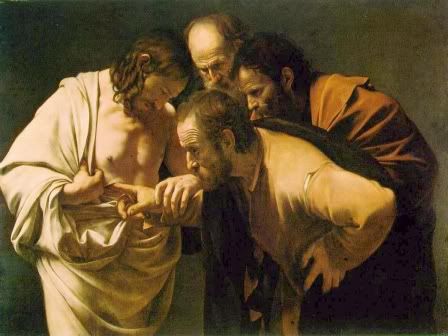
Why I don't buy Richard Carrier's article 'why I don't buy the resurrection,'


  photo caravaggio-thomas.jpg


 I'm going against advice and deal with arguments by carm atheists because I think it's important to remember that certain things have been answered. Dealing with an old article by Richard Carrier that was sighted recently on CARM. Even though it's old these guys are rallying around it like its new and the same bunck is being noised about by atheists all the time.


Carrier's article is here:

http://infidels.org/library/modern/r...n/lecture.html

this is prompted by Fleetmouse's statement that:

"You have no answers to Carrier's essay. "

He seems the most worked up over the idea that since carrier proves the superstitious nature of the folks of Jesus day, like he never considered that. That's something I knew about as a kid. I used it in highschool to justify my own atheism (1973).  I can't imagine anyone being impressed by it. Be that as it may that's not an argument so examine it.

  photo 180px-RichardCarrierSM.jpg
Carrier


My first reaction to reading  the beginning is it's an argument from analogy based upon ideological assumptions. the argument itself assumes what all atheists assume "anything that tells us a SN event can happen must be wrong a priori" they always jump the track form that (the SN itself must be wrong) to "the historicity must be wrong as well.That's really nothing but good old fashioned doubt. This is something in which I refuse to believe, therefore, it can't be true.

To reinforce it he uses argument from analogy. He shows the story about some saint in the 500s which is ridiculous. Then asserts that because that story is false then the NT stories are false. That is argument from analogy that is not proof. There's a huge difference in the level of evidential understanding, claim and documentation in first century and sixth. Sixth century story is European and not Mid eastern. They had an even more tenuous grasp of proof and testimony than did the Mediterranean folk who had the Greeks to teach them. From point on the answers to his essay are just the regular arguments one finds in any argument about the res. I'll have more on it latter.


Te then asserts Hume's foolishness that "why doesn't this happen today. it does. In fact he's begging the question. We have tons of miracle claims from the current era and some good science that shows they are unexplained. The only factor that is different is the prayer, so prayer is the logical candidate to explain it. In addition to the Lourdes stuff (above link) there is also the Casdroph evidence. While not as systematic or rigorous it does have the evaluation of a medical staff of a hospital in the 70s.

Carrier is using an example from the time of legends in the dark ages which is not backed by anything like the kind of testimonial support of the Gospels.In making that argument he's just begging the question and asserting the ideology of naturalism. He evoking doubt as a fact rather than proving facts. again, he is privileging doubt. Doubt privileged means doubt becomes proof. The dark age European stuff has nothing like the eight levels of verification that I've demonstrated back the Gospels.

Let's examine his specific arguments. Carrier states:


But we should try to be more specific in our reasons, and not rely solely on common sense impressions. And there are specific reasons to disbelieve the story of Genevieve, and they are the same reasons we have to doubt the Gospel accounts of the Resurrection of Jesus. For the parallel is clear: the Gospels were written no sooner to the death of their main character--and more likely many decades later--than was the case for the account of Genevieve; and like that account, the Gospels were also originally anonymous--the names now attached to them were added by speculation and oral tradition half a century after they were actually written. Both contain fabulous miracles supposedly witnessed by numerous people. Both belong to the same genre of literature: what we call a "hagiography," a sacred account of a holy person regarded as representing a moral and divine ideal. Such a genre had as its principal aim the glorification of the religion itself and of the example set by the perfect holy person represented as its central focus. Such literature was also a tool of propaganda, used to promote certain moral or religious views, and to oppose different points of view. The life of Genevieve, for example, was written to combat Arianism. The canonical Gospels, on the other hand, appear to combat various forms of proto-Gnosticism. So being skeptical of what they say is sensible from the start.[1]

That's exactly why we can't compare that story to the resurrection. Not only is it from a different time and different culture but it was written for different reasons. The Gospels were primarily written to answer concerns of given communities of the early chruch. Their concerns revolved around securing the testimony of their cloud of witnesses as they began dying off. They were making the transition from oral culture to written culture. They were deal with the original testimony of eye witnesses. The European guys were dealing with a palimpsest [2] of  legend that never had that kind of eye witness support. Thus they are not analogous and the argument from analogy fails.

Carrier asserts the typical atheist pechant for 19th century dating of the Gospels.

It is certainly reasonable to doubt the resurrection of Jesus in the flesh, an event placed some time between 26 and 36 A.D. For this we have only a few written sources near the event, all of it sacred writing, and entirely pro-Christian. Pliny the Younger was the first non-Christian to even mention the religion, in 110 A.D., but he doesn't mention the resurrection. No non-Christian mentions the resurrection until many decades later--Lucian, a critic of superstition, was the first, writing in the mid-2nd century, and likely getting his information from Christian sources. So the evidence is not what any historian would consider good.
Note he stresses that it's all "sacred" that means in atheist speak we can't trust it because anything religious people write must be a lie and propaganda. Of course any testimony in favor of the resurrection would be sacred so there can't be any such thing as pro res evidence that is not a lie and can be trusted. He implies that the resurrection was not part of the faith until early second century or there about. That's an old fashioned view that was disproved a long time ago. Now the consensus in the field is Koester's notion of the pre Mark Passion narrative with empty tomb emerging in  mid first century. "John Dominic Crosson has gone further [than Denker]...he argues that this activity results in the composition of a literary document at a very early date i.e. in the middle of the First century CE" [3]

 Now we find one of the more ridiculous tactics to which Carrier resorts. He pulls a bait and switch between historian's standard of evidence and the atheists own standard.

Nevertheless, Christian apologist Douglas Geivett has declared that the evidence for the physical resurrection of Jesus meets, and I quote, "the highest standards of historical inquiry" and "if one takes the historian's own criteria for assessing the historicity of ancient events, the resurrection passes muster as a historically well-attested event of the ancient world," as well-attested, he says, as Julius Caesar's crossing of the Rubicon in 49 B.C.[5] Well, it is common in Christian apologetics, throughout history, to make absurdly exaggerated claims, and this is no exception. Let's look at Caesar's crossing of the Rubicon for a minute:
He's going to through a list of things where the documentation for Caesar is supposedly so much better than the Gospels. First of all, this is a total the reality of the issues. In setting up the idea that Caesar is better documented the notion of an atheist victory is looming. The problem is we should really expect that because Cesar was the ruler of the known world at that time. Jesus was an itinerant prophet form the sticks who did not even interest the historians or men of letters. That we have any testimony of Jesus is a miracle. The idea that Caesar is better documented is not proof that Jesus is badly documented. Moreover, it may be overstated that Jesus' evidence is better (he did quote a perhaps rash comment to that effect) yet let's examine the aspects of the statement and see they are using two different sets of criteria.

First he argues that we have Caesar's writings, we have no writings of Jesus. He asserts that this equates to not knowing what Jesus said or believed. We actually more about Jesus beliefs than Caesar's becuase while Caesar express some ideas Jesus is quoted by his followers in a full body of teaching that covers many aspects. Since the Jews had an oral culture in which they memoirs the words of their teachers and spit them back ver batiam we probalby do have a good accurate understanding of Jesus' teachings, at least as they were applied by his first follows a few years after the communities were established. Oral tradition was not just wild random rummer but actuate reflection of the teacher through the student's memorization. It worked and there is a great deal of evidence to that effect.

Secondly he records the fact that at least one of Caesar's enemies documented his crossing the Rubicon, that is Cicero. While he argues that there are no such records of Jesus enemies or neural particles that is not the case. There's good documentation that Jesus was written about in the Talmudist writings, some of those date to first century.MICHAEL L. RODKINSON in his translation of the Babylonian Talmud says:

Thus the study of the Talmud flourished after the destruction of the Temple, although beset with great difficulties and desperate struggles. All his days, R. Johanan b. Zakkai was obliged to dispute with Sadducees and Bathueians and, no doubt, with the Messiahists also; for although these last were Pharisees, they differed in many points from the teaching of the Talmud after their master, Jesus, had broken with the Pharisees...[4]

 Moreover the fact that Talmudic sources talked about Jesus is born out by Celsus. The points that he says the Jews gave him are things the Talmud says about the alleged "Jesus figure." See my pages on Jesus in the Talmud for good documentation.

 He also includes inscriptions on coins. That's not a good source and it doesn't prove much. We had a dime with Mercury on it. That doesn't mean Mercury was a real guy. Coins documented legends and mythology.

He tires to use mulitiple sources to establish Caesar's crossing the Rubicon:
    
    Fourth, we have the story of the "Rubicon Crossing" in almost every historian of the period, including the most prominent scholars of the age: Suetonius, Appian,Cassius Dio,  Plutarch. Moreover, these scholars have a measure of proven reliability, since a great many of their reports on other matters have been confirmed in material evidence and in other sources. In addition, they often quote and name many different sources, showing a wide reading of the witnesses and documents, and they show a desire to critically examine claims for which there is any dispute. If that wasn't enough, all of them cite or quote sources written by witnesses, hostile and friendly, of the Rubicon crossing and its repercussions.
 
 Just having good sources, or even better vetting than the Gospels, is not proof that the Gosples have no historical basis. It may or may not be true that the statement by Douglas Geivett  might be a bit of an exaggeration in being as well attested as the crossing of the Rubicon. Nevertheless that is not proof that the Gospels don't hold up. I also say we can give Carrier a good run for his money. He only names three sources that back the crossing, they are not eye witnesses. We have four sources that are eye witnesses. Although in reality it's all coming form the pre Mark Passion narrative. Yet the veracity of it is attested to by it's use in other sources. So in using in four Gospels the communities produces those Gospels are saying "this source is correct." That's not counting non canonical gospels that agree with it. one I now of is GPete (Gospel of Peter). That's at least five attestations. Moreover, the sources Carrier sites for backing the crossing were not eye witnesses and were not contemporary, probably got their information from Caesar's writings.[5] That is not even verification.

At this point Carrier makes several absurd statements: "Compare this with the resurrection: we have not even a single established historian mentioning the event until the 3rd and 4th centuries, and then only by Christian historians." That's not true first of all. We have the attestation of Papias, his writings dated bewteen 95 and 120 AD. That he sure was before the third century. Clement of Rome is said to have been writing around 94 AD. Polycarp's death is attributed to 155 AD..The point is all of these guys attest to the resurrection and all of them claim to have had ties with actual disciples and Apostles who Knew Jesus. One might argue that they are not established historians but the historians of that era were not academically trained social scientists they were just any educated person who wrote about what hapepned in the past these guys have a link to the eye witness testimony that has to outweigh the onus of being "chruch historians." The historians writing about Caesar probalby got their information form Caesar. Carrier goes on, "And of those few others who do mention it within a century of the event, none of them show any wide reading, never cite any other sources, show no sign of a skilled or critical examination..."That's just not true. All of the afore mentioned chruch father attribute their knowledge to eye witnesses, within whom they had personal contact. None of the historians Carrier sites can do that for the crossing. He says they dont' show wide reading or skill as historians. That is nonsense. Clement of Rome (who seems to have known both Peter and Paul) seems to be widely read. His letter is elpqunt and shows a vast learning as a complex concept of the Gospel is presented. Carrier might refuse to accept because the content is Christians but no oen can deny the complexity. Moreover that's just not necessary to the honesty and knowledge level of the witnesses. So what if they are not great writers compared to Plutarch, that doesn't negate the first hand nature of their evidence.

Here he makes an argument that is quite fallacious. It's so telling that all the CARM atheist acted like it's a big proof:
    
    Fifth, the history of Rome could not have proceeded as it did had Caesar not physically moved an army into Italy. Even if Caesar could have somehow cultivated the mere belief that he had done this, he could not have captured Rome or conscripted Italian men against Pompey's forces in Greece. On the other hand, all that is needed to explain the rise of Christianity is a belief--a belief that the resurrection happened. There is nothing that an actual resurrection would have caused that could not have been caused by a mere belief in that resurrection. Thus, an actual resurrection is not necessary to explain all subsequent history, unlike Caesar's crossing of the Rubicon.

That's just shifting arguments. In effect he's saying if this event had no happened historian would be different so therefore we know it happen. That is a silly way for any historian to think.The fact is yes some group of solider moves across teh river to fight Pompey and that changed Roman history. That means they got men across the river. that in no way proves that Caesar led them or that any  other things Caesar says really happened the way he says it. That's like saying we know that JFK was shot by a lone gunman becuase had he not been shot he would have ran for re-election. History would be different, so therefore it was a lone gunman. The same fallacy works with the claim that it proves is that the assassination was a conspiracy. All it proves is that the President was assassinated.

Moreover, he asserts: "There is nothing that an actual resurrection would have caused that could not have been caused by a mere belief in that resurrection." That's really a red herring because there would be no belief without an empty tomb, and they could not have gotten the body past the guards had he not risen from the dead. To answer that this could be held by mere bleief and didn't require a real resurrection is nothing but begging the question. We can't assert that we know there was true resurrection just because bleief in resurrection might have flourished without an actual event. We don't really know that it did, and there is a possibility that the belief would not be possible with an actual event. That is rather a moot point and it is no way to do history!

The big historian's brilliant knowledge fails to impress. There is one other major issue that the CARM folks were so taken with. he argues that superstition was  so rampant in that day they would bleieve anything. That's supposed that prove it didn't happen.  Some of the CARM atheists seemed to think this is some big innovative to show the superstition level of the day. I knew about that as a child. I sued that argument in my pro atheism arguments when I was a junior in high school.

But reasons to be skeptical do not stop there. We must consider the setting--the place and time in which these stories spread. This was an age of fables and wonder. Magic and miracles and ghosts were everywhere, and almost never doubted. I'll give one example that illustrates this: we have several accounts of what the common people thought about lunar eclipses. They apparently had no doubt that this horrible event was the result of witches calling the moon down with diabolical spells. So when an eclipse occurred, everyone would frantically start banging pots and blowing brass horns furiously, to confuse the witches' spells. So tremendous was this din that many better-educated authors complain of how the racket filled entire cities and countrysides. This was a superstitious people.

the sources he footnotes are an article by himself and his Masters thesis. In those articles he quotes other source but does not document with standard method of FN. He never shows that the superstitions about eclipse were prevalent in Jerusalem in the Time of Jesus, nor does he show that people were so set on them that they could be convinced to see things that weren't there.

He talks at length about how people in that day were certain that an eclipse was a witch stealing the moon or a Dragon easting the sun. the idea that they would believe an eclipse was special dragon eating the sun or witch stealing the moon or something. That doesn't prove that they would believe in a resurrection just because they are told about it. Carrier would assert this but it's the opposite: the eclipse is a real event that is very dramatic. It's rarity and its' encompassing nature, it seem terrifying and mysterious. It's really happening, the sun really goes away for a bit. That doesn't prove they would believe something just becuase they are told about it. That proves the opposite really that there has to be a real event that's terrifying and out of the ordinary to trigger such belief. A real resurrection would fill the fill the bill,I don't know what else would.

Another problem is that he doesn't even bother to document the time or place of Jesus day. He's not quoting evdience about how Jews of Jesus time thought. He's asserting that all ancinet world people thought the same. that's an old atheist assumption that all ancient people are stupid.

Only a small class of elite well-educated men adopted more skeptical points of view, and because they belonged to the upper class, both them and their arrogant skepticism were scorned by the common people, rather than respected. Plutarch laments how doctors were willing to attend to the sick among the poor for little or no fee, but they were usually sent away, in preference for the local wizard.[10] By modern standards, almost no one had any sort of education at all, and there were no mass media disseminating scientific facts in any form. By the estimates of William Harris, author of Ancient Literacy [1989], only 20% of the population could read anything at all, fewer than 10% could read well, and far fewer still had any access to books. He found that in comparative terms, even a single page of blank papyrus cost the equivalent of thirty dollars--ink, and the labor to hand copy every word, cost many times more. We find that books could run to the tens or even hundreds of thousands of dollars each. Consequently, only the rich had books, and only elite scholars had access to libraries, of which there were few. The result was that the masses had no understanding of science or critical thought. They were neither equipped nor skilled, nor even interested, in challenging an inspiring story, especially a story like that of the Gospels: utopian, wonderful, critical of upper class society--even more a story that, if believed, secured eternal life. Who wouldn't have bought a ticket to that lottery? Opposition arose mainly from prior commitments to other dogmas, not reason or evidence.

He's talking about Europe in the middle ages.He has some application to first century meridian. That's a long way from proving that a whole popular would up and believe in resurrection just become people started saying someone rose form the dead. Some of the advocates of resurrection were those educated men who were not carried by superstition. Paul and Luke fall into that category. Some of the Romans Paul was talking to in his letter to the Romans would fall into it. Priscilla,Paul's friend the wife of Aquila probalby, since her name is a Patrician name.


End notes


[1] Carrier FN at this point:

Besides my summary of Metzger on The New Testament Canon, cf. R. Burridge, What are the Gospels? A Comparison with Graeco-Roman Biography (1992); H. Koester, Ancient Christian Gospels: Their History and Development (1990); W. Lane's New London Commentary on the New Testament (1974); and also Bart Ehrman's The Orthodox Corruption of Scripture: The Effect of Early Christological Controversies on the Text of the New Testament (1993).

[2] palimpsest:
noun
noun: palimpsest; plural noun: palimpsests
  1. a manuscript or piece of writing material on which the original writing has been effaced to make room for later writing but of which traces remain.
    • something reused or altered but still bearing visible traces of its earlier form.
      "Sutton Place is a palimpsest of the taste of successive owners"
[3] Helmutt Koester. Ancient Christian Gospels:Their History and Development.
.
Harrisburg, PA: Trinity Press International. 1990, 218.
[4] Babylonian Talmud, Book 10: History of the Talmud, tr. Vol 1 Chapter 2
 THE DEVELOPMENT OF THE TALMUD DURING THE LAST CENTURY OF THE SECOND TEMPLE'S EXISTENCE (i.e. THE FIRST A.C.) SHEMAIA--ABTALIAN--HILLEL--SHAMMAI--THE PRINCES (NASIS) OF ISRAEL--R. JOHANAN B. ZAKKAI--SANHEDRIN OF JAMNIA--THE JEWISH CHRISTIANS.accessed 9/6/14 
by Michael L. Rodkinson, [1918], at sacred-texts.com accessed 9/6/14
 The Talmud was written in second century on, but the works it used were passed on orally and date much earlier. Rodkinson states:
 "The Talmud is a combination of Mishna and Gemara, the latter is a collection of Mishnayoth, Tosephtas, Mechilta, Siphra, Siphre and Boraithas, all of these, interpreted and discussed by the Amoraim, Saboraim, and also Gaonim at a later period. "The Mishna is the authorized codification of the oral or unwritten law, which on the basis of the written law contained in Pentateuch, developed during the second Temple, and down to the end of the second century of the common era." The author of which was R. Jehuda, the prince named "Rabbi" (flourishing toward the end of the second century), taking the unfinished work of R. Akiba and R. Meir as basis."
[5] Caesar crossed the Rubicon in 49 AD. Suetonius wasn't born until 70 AD! Appian was bron in 95 AD  Cassius Dio born in 155,
Plutarch born in 45 AD. so he could have been there if he had been taken along as a two year old historian.


On CARM HRG says: " It is mentioned in De bello civile, Cicero's Philipplicae and Velleius Paterculus. " http://forums.carm.org/vbb/showthread.php?200585-why-I-don-t-buy-Carrier-s-article-about-not-buying-the-Res

Interesting that Carrier didn't use those guys becuase he has a Ph.D. in world history, so he surely would have known they were contemporary with the event. He must know of them. But one might well wonder were they there or did they know if  from reading Caesar? Sure they knew the crossing was alleged to have existed, that doesn't mean they were there.

Monday, March 17, 2014

Richard Carrier: Acts as Historical Fiction, or Atheist Fictional History?

 photo journeys_zpsa088cfc1.gif


An Article by James McGrath about an article by John Loftus (his blog 3/14/14), about a lecture by Carrier. I can't get the original lecture. Of course Carrier spits on the traditional view that Luke was a good historian. He doesn't stop there, he denies that Luke was even trying to be an kind of historian. According to McGrath, Luke was pretending to do historical research in his preface. Moreover, Carrier charges that Luke's method was sub standard.[1] According to McGrath's report of Carrier he argues that Luke's statement about using sources means he was claiming to slavishly follow them but then he did not.

Carrier assumes that Luke is a novel. He thinks there was a genre of ancinet novel and that these novels always included travel, miracles and divine revelation. Paul and Lydia are an ancient literary type the chaste couple reunited. This shows the Ignace of modern historians as novels didn't exist utnil early modern times:
Unlike poetry and drama, which go back thousands of years to works such as the Babylonian Epic of Gilgamesh (c. 2000 B.C.) and the Greek play Oresteia (458 B.C.), the novel is a somewhat recent literary creation.  Lengthy fictional narratives written in prose had appeared sporadically before 1700; examples include the stories in Italian writer Giovanni Boccaccio’s Decameron (1351-1353), the English romancer Thomas Malory’s Le Morte d’Arthur (c. 1469), and Don Quixote (1605, 1615), by Miguel de Cervantes of Spain.  These early precursors aside, some scholars date the birth of the modern novel to the eighteenth century, specifically the publication of the English printer Samuel Richardson’s Pamela, or Virtue Rewarded (1740-1742), a long story recounting the trials of an English girl in a battle against a man trying to seduce her.[2]
For that matter there were no real historians in that day, not the sense that we know them. There was no academic world, no Ph.D. given in history. Historians were not thought of as social scientists. They didn't have the standards of documentation or scholarly caution that we have today. On that basis one could say there were no historians, if that's all we can all historian, modern academics. Even Tacitus was not a historian. There's no basis for the idea that Luke was not writing about true events to which he was witness. There's no reason to think he did not have a standard of using best evidence and no reason to think that he didn't critically make us of what he thought was authoritative and let go that which he thought was not.

According to McGrath Carrier charges Luke with "lying" that's how he explains the differences between Luke's account and Paul's accounts of the same episodes in Galatians. McGrath makes the point that Carrier calls this "revisionist history" but then how could it be that if it's a novel?[3]
His suggestion that Luke mistook “Gerazim” for “Galileans” seems unlikely. But he does present an interesting summary of the possible evidence for Luke drawing on Josephus, which some mainstream scholars have proposed. But once again, Carrier says that in reproducing Josephus, Luke is thus “not writing history,” which is rather bizarre. Drawing on a historian does not by any stretch of the imagination prove that someone is not trying to write history!!![4]
There are several other silly clams McGrath reports that I wont go into, For example Figures in Acts are designed to be parallel to Jesus, that's important for the Jesus myther aspect of Carrier's thought. I will focus on two issues, the over historicity of Acts and the issue that Luke copied Josephus. For a general defense of Luke as a historian in his Gospel see my Doxa page on Luke.

Luke as historian

One of the major aspects Luke's good historicity is his getting right the names of officils and the accurate title of their offices. Stephen Neil makes the point that Luke get's all of the titles correct in Acts, all the minor officials in every little localities, even titles which were thought previously to have been wrong archaeology has proven Luke right.[5] He also is right about the individuals who inhabited offices during the time of the book of Acts. Just to give a few examples. The pool of Bethseda in Luke where the angle "troubled the waters" for healing, and Jesus healed the lame man and told him to take up his bed and walk, has been discovered beneath the Church of ST. Anne. There is a pool at the bottom of a flight of stairs and an ancient fresco with a picture of an angel troubling the waters.[6]  In Romans 16:23 Paul sends greetings from Erastus the city treasurer. IN Corinth an inscription has been found which mentions Erastus [7] Harnack and others attest to Lukes accuracy in terms of the ship wreck on Malta, the flavor and historicity of the cities he speaks of the, the time period and all other verifiable elements of this nature. Neil thought that one of the most impressive aspects of Luke as an historian is that he always gets the titles write. Many of the titles of local officials which Luke provides us with were not validated until modern times.
"The writter of Acts knew the correct titles and used them with varying percision. In the words of Ramsey: 'the officials with whom Paul and his companions were brought into contact are those who would be there. Every person is found just where he ought to be; procounsuls in senatorial provences, asiarchs in Ephesus, strategoi in Philippi, politarchs in Thessolonica, magicians and soothsayers everywhere.' The Most remarkable of these titles is Politarch the ruler of the city used in Acts 17:6...previously this word had been completely unknown except for this passage in Acts. It has now been found in 19 inscriptions dating from he second century..." [8]
Neil argues that titles are the hardest things to get right, modern French writers never get English titles right, and this is something that would easily and surely betray an anachronism [9]. Historians of the modern day judge Luke a superb historian.It is true that Luke could have made up the events of Jesus' ministry and just used factual information to write the narrative. But it is absurd to think that Luke would traps all over Palestine to learn the little obscure titles of minor officials, because he is right about the exact people in authority at the time and the exact titles they held. This is clearly the work of an eye witness not merely a fictional writer. This is not some minor formality to get the things right, it's an indication he was really there on the trip. Now he could have just been on the trip at some other time and used the knowledge for his fictional writing, but anyone who argues that is struggling to preserve the argument against all likelihood. He says he was there, the fact that he was tallies with some of the things Paul says in Galatians so why not assume he was there?

 "Sir William Ramsay who devoted many fruitful years to the Archaeology of Asia Minor testifies to Lukes intimate and accurate acquaintance and the Greek East at the time with which his writings deal."[10] Ramsay began as a Tubingen liberal, believing Luke to be a second century production with no validity. By the end of his life he was so persuaded of the truth and validity of Luke that he gave up scholarship and became an Evangelist and apologist using arguments based upon the discoveries he had made.[11] It cannot be claimed that he was not an "objective" scholar, as he is one of the greats of the field. Dr. Henry J.Cadbury delivered the Lowell lectures in 1953 and produced a work on the Book of Acts in which he hailed Luke as a first rate historian.[12]

Did Luke Copy Josephus?

the Carrier article on Luke and Josephus can be found here.

Strange theory because it has Chrsitians making up the things Jo said about Jesus, but then it also has Luke copying them to use for Acts. That's possible but kind of cumbersome. There are not very many scholar who credit that kind of senerio. One of the most important sources the reader should consult is the Flavious Josephus homepage by J.G. Goldberg.[13] Goldberg has asked that people not quote him. I will summarize a few things but I recommend highly that the reader to go his pages and read them. There he sets all the passage side by side, Luke and Jo and makes helpful comments about them. Golberg does say that Luke is concerned with embedding Jesus in a historical context, that would put him at odds with Carrier who thinks he was writing fiction. Oddly enough he thinks that Luke quoting a historian in order to write fiction. Add to this that Luke apparently did travel to all the places he writs about for the missionary journeys. So he copied a historian so he would write a fictitious account of a journey he actually made himself?

Victor Repport has a gine article which summarizes arguments of Tim McGrew on Carrier's arguments about Luke and Josephus.[14] McGrew jokes that the parallels are so general he wonders why he left out that both mention Rome.
The list of “story parallels” is even worse, since in many cases it involves torturing the notion of a parallel. Just run through the list and note some of the (non)parallels that he either vastly overrates or twists ’round:

* In Josephus, the census under Quirinius is the beginning of something bad. In Luke, it isn’t. Therefore, this is a parallel where Luke “transvalues” the message of the census, changing “bad” into “good.”

(Um, ... standards ...?)

* Josephus says that there were many men who led revolts, and he names three prominent ones. Luke has passing references to three persons with the same names, though it is not clear that Luke’s “Theudas” is the same as Josephus’s. One of the men is called “the Egyptian” by both Josephus and Luke; Luke links him with the sicarii, whereas Josephus does not. Therefore, Luke was copying from Josephus.

(The argument that this must be copying because there were thousands of Egyptians in Palestine at the time is beyond ridiculous. It would work equally well against two independent references to Jimmy the Greek. (“How many millions of Greeks,” etc.))

* Luke and Josephus both recount the death of Agrippa I in some detail, speaking of his brilliant robe, his acceptance of adulation as a God, and his immediate demise. There are also some details that differ in the two stories. Therefore, Luke must have borrowed it from Josephus.

(It couldn’t just be a notorious fact? Why not?)

* Josephus mentions a rumor that there was an incestuous relationship between Agrippa II and Bernice; Luke does not. Therefore, Luke is inspired by Josephus and intends the entire scene in Acts 25 as comic sarcasm.

(Does it seem like sarcasm? Can it by any legitimate stretch of the imagination be read that way?)

* Josephus reports that Drusilla abandoned her husband for Felix. Luke (Acts 24) portrays Paul as speaking to Felix about righteousness, self-control, and the judgment to come, Felix becomes uncomfortable. Therefore, Luke must be using Josephus.[15

This is just the kind of thing I would expect form the mythers. Some of their parallels (Carrier's) are hilarious. Here's a priceless one Reppert mentions:

* "Josephus portrays Felix as sending priests, “excellent men,” to Rome for trial on petty charges. Luke portrays Paul as demanding to be sent to Rome. So perhaps Luke was using Josephus as a model."

Reppert adds:

(Huh?)

Hey, it makes perfect sense to me, but then I've been posting on CARM since 1998.

Sources

all online sources accessed 3/16/14.

[1] Jame McGrath, "Richard Carrier on Acts as Historical Fiction." Exploring our Matrix, blog on Pathos: Progressive Christian Channel. March 13, (2014) http://www.patheos.com/blogs/exploringourmatrix/2014/03/richard-carrier-on-acts-as-historical-fiction.html
[2] Mark Canada, "Introduction to the novel." Eng.343: The American Novel. educational resource on line http://www2.uncp.edu/home/canada/work/markport/lit/amnovel/fall2002/01intro.htm
this is a class syllabus-type material Mark Canada is professor at University of North Carolina at Pembroke.
[3] McGrath, Op cit.
[4] Ibid.
[5] Stephen Neil, The Interpriation of the New Testament:1861-1961, London: Oxford Univesity press, 1964, 143.
[6] F.F. Bruce, The New Testament Documents Are they Reliable? Jefferson, Grand Rapids, Cambridge England: Published Jointly in USA W.B Eerdmans Publishing Company, by 1943, 1981 94
[7] Ibid. 95
[8] Stephen Neil,Op. Cit, 143.
[8]  Ibid.,147
[10] Ibid., 90
[11] Ibid.
[12] Ibid.
[13] J.G. Goldberg, "New Testament Parallels to the Works of Josephus," The Falvious Josephus Home page http://www.josephus.org/ntparallels.htm
[14] Victory Repport, "Tim McGrew on Carrier's Treatment of Luke and Jospheus," Dangerous Idea
blog http://dangerousidea.blogspot.com/2010/08/tim-mcgrew-on-carriers-treatment-of.html
McGrew is professor of Philosophy at Western Michigan University.
[15] Ibid.

Thursday, July 25, 2013

Jesus "Myther" Use of the Southern Cross

 photo image003_zpsdeabeb77.jpg

I came across a video on you tube[1] which was attempt to use the Acharya S thing about son to imply copy cat savior thing. pun on 'sun' and 'son.' Acharya S. She was a Jesus myther who believed that little gray aliens commissioned her to destroy Christianity. She is well known as a crap pot who says outrageious things. Consider her answer to a critic who calims Jesus myth theory was new:

Truth be known
"This thinking," i.e, that Jesus Christ is a mythical character, is not at all a "new fad." It has been around since the very beginning, because the intelligentsia of the ancient world knew that what the early Church fathers were palming off was mummified mythology. As Rev. Robert Taylor says:
And from the apostolic age downwards, in a never interrupted succession, but never so strongly and emphatically as in the most primitive times, was the existence of Christ as a man most strenously denied.
Indeed, the first and second epistles of John were written principally to combat such deniers of the historical Christ. (1 Jn. 4:2-3; 2 Jn. 7) The denial of "Christ come in the flesh" is an early "heresy" called "Docetism," whose proponents not only abounded during the first centuries of the Christian era but were the original "Christians," i.e., Gnostics.[2]


 Here she pulls a bait and switch talking about Jesus divine nature as something that had been argued for and therefore opposed, but not his existence in history. That's a constant game the mythers play to talk about the existence of the man as though it disproves the divine nature and the divine nature as though ti disproves the existence of the man. The original argument was the idea that Jesus did not exist as a man or any kind of entity in history (flesh and blood) is new. That she does not answer.

Quoting the gnostic is a trick becuase their assertion that Christ did not come in the flesh is not be understood as denial that was a man called Jesus of Nazareth. They claim he was illusory and not flesh and blood but to all appearances seemed to be a  man in history. They don't deny the place holder "Jesus of Nazareth" thought to be a flesh and blood man by those who saw him. They impose their doctrine on him they don't deny his existence. She would have believe that the "Christ come in the flesh" issue dines there was such a man which is highly dishonest. That's a sample of her dishonesty.

This video follows suit form her example which argues that designation of Jesus as "son" of God was either a ply on words or a degeneration from the worship of the sun in pagan culture. The problem is the Greek word for "son" and the English word for sun sound nothing alike. So the pun can't be name thus the connection is not there in history. Another dishonesty. Greek word for son is υἱός (hyiús, hyiós), while the Greek word for sun is Ἥλιος (Helios). They are pronounced in very different ways. "wee-os" vs Hel-i-os.

dying rising savior god stuff. new cast of characters.

I notice they have changed the characters (on the video) as to who the dying rising savior Gods' were. That's becuase we stomped all over their original set. NO pun (Egyptian god "Set").  First they talked about Horus, we kicked the crap out of that then they switched to Osiris. Then we kicked the crap out of that, now they use gods so obscure I've never heard of them. the proof is clear. when we look at the real myth books, real scholars writing about myth not trying to destroy Christianity we find the similarities all go away. See my Copy cat savior page on Doxa.
still have the anchor cross.

sacred day of worship for mithra was "sunday"

That BS again! they still haven't learned. There is no proof that anywhere. The fact about mithrism is we have no writings about the cult but what was said by chruch fathers. They were highly secretive. We can't know that Sunday was sacred to them. What if it was? It was probably sacred to a lot of groups that doesn't prove that Christians shifting to Sunday means Jesus was copied after pagan myth.

from the copy savior page: Almost no Textual evidence exists for Mithraism

Most of the texts that do exist are from outsiders who were speculating about the cult. We have no information form inside the cult.

Cosmic Mysteries of Mythras (website--visted July 1, 2006)

David Ulansey (the Major scholar of Mithraism in world)
Owing to the cult's secrecy, we possess almost no literary evidence about the beliefs of Mithraism. The few texts that do refer to the cult come not from Mithraic devotees themselves, but rather from outsiders such as early Church fathers, who mentioned Mithraism in order to attack it, and Platonic philosophers, who attempted to find support in Mithraic symbolism for their own philosophical ideas.
"At present our knowledge of both general and local cult practice in respect of rites of passage, ceremonial feats and even underlying ideology is based more on conjecture than fact." (Mithraic Studies: Proceedings of the First International Congress of Mithraic Studies. Manchester U. Press, 1975. ,437)

And Cumont himself observed, in the 50s

"The sacred books which contain the prayers recited or chanted during the [Mithraic] survives, the ritual on the initiates, and the ceremonials of the feasts, have vanished and left scarce a trace behind...[we] know the esoteric disciplines of the Mysteries only from a few indiscretions." (Cumont, Franz. The Mysteries of Mithra. New York: Dover, 1950.152)


(b) Roman Cult began after Jesus life
Our earliest evidence for the Mithraic mysteries places their appearance in the middle of the first century B.C.: the historian Plutarch says that in 67 B.C. a large band of pirates based in Cilicia (a province on the southeastern coast of Asia Minor) were practicing "secret rites" of Mithras. The earliest physical remains of the cult date from around the end of the first century A.D., and Mithraism reached its height of popularity in the third century. (Ulansey, David. Cosmoic Mysteries of Mithras (website)
(c) No Continuity between Ancient Persian past and Roman Cult

Throughout most of the twentieth century Franz Cumont so influenced scholarship that the entire discipline followed in the wake of his assumption that the Roman cult was spread by the Persian cult. In the early 70's David Ulansey did for Mithric scholarship what Noan Chomsky did for linguistics, he totally redefined the coordinates by which the discipline moved. Ulansey showed that the Roman cult was not the continuance of the Persian cult, that there was no real evidence of a Persian cult. He showed that the killing of the great comic bull which latter became the major event in Mithraism, and the parallel from which Jesus Mythers get the shedding of blood and sacrifice, was not known in the Persian era. This was be like showing that the story of the Cross was not known to Christians in the first century. The major likeness to Christianity and the central point of the cult of Mithraism was not known in the time of Christ, in the time Paul, or for at least two centuries after:
"There were, however, a number of serious problems with Cumont's assumption that the Mithraic mysteries derived from ancient Iranian religion. Most significant among these is that there is no parallel in ancient Iran to the iconography which is the primary fact of the Roman Mithraic cult. For example, as already mentioned, by far the most important icon in the Roman cult was the tauroctony. This scene shows Mithras in the act of killing a bull, accompanied by a dog, a snake, a raven, and a scorpion; the scene is depicted as taking place inside a cave like the mithraeum itself. This icon was located in the most important place in every mithraeum, and therefore must have been an expression of the central myth of the Roman cult. Thus, if the god Mithras of the Roman religion was actually the Iranian god Mithra, we should expect to find in Iranian mythology a story in which Mithra kills a bull. However, the fact is that no such Iranian myth exists: in no known Iranian text does Mithra have anything to do with killing a bull." (David Ulansey Mithras Mysteries).[3]
(5) Mithraism Emerged in the west only after Jesus' day.
Mithraism could not have become an influence upon the origins of the first century, for the simple reason that Mithraism did not emerge from its pastoral setting in rural Persia until after the close of the New Testament canon. (Franz Cumont, The Mysteries of Mithra (Chicago: Open Court, 1903), 87ff.)


use the southern cross 

Come to the video the funniest thing about it is that they try to use the southern cross, constellation in the southern hemisphere, as proof that the Christian cross comes form pagan sources. They are tyring to say it was based upon astrological symbol. The problem is the souther cross, while visible form north wasn't seen as a cross and wasn't called cross until several centuries after Bible times when explorers when down the coast of Africa.


Universe Today
Southern Cross Constollation


The first recorded example of Crux’s discovery was around 1000 BC during the time of the Ancient Greeks. At the latitude of Athens, Crux was clearly visible, though low in the night sky. At the time, the Greeks identified it as being part of the constellation Centaurus. However, the precession of the equinoxes gradually lowered its stars below the European horizon, and they were eventually forgotten by the inhabitants of northern latitudes. Crux fell into anonymity for northerners until the Age of Discovery (from the early 15th to early 17th centuries) when it was rediscovered by Europeans. The first to do so were the Portuguese, who mapped it for navigation uses while rounding the southern tip of Africa. During this time, Crux was also separated from Centaurus, though it is not altogether clear who was responsible. Some attribute it to the French astronomer Augustin Royer who did it in 1679 while others believe it was Dutch astronomer PetrusPlancius who did the deed in 1613. Regardless, it is believed to have taken place in the 17th century, placing it within the context of European expansion and the revolution that was taking place in the sciences at the time.
 

Read more:  southern cross.


 That doesn't give me a lot of confidence in their research. Another aspect of their failed research is the use of the anchor Cross. It's an amulet of Orpheus who is tired to an anchor but it makes a cross. This has been exposed as a fake. James Hannam has has a detailed critique of it.[4] Richard Carrier tries to defend it. His major argument is that it's not a cross but just an anchor. If that's the case then it loses it's connection to Jesus.[5] The point of it is, as used by Timothy Freke and Peter Gandy to imply that the cross comes to Christianity from pagan sources becuase there was no Jesus thus no Jesus' death on cross. To say it's just a picture or Orpheus tied to an anchor may save the mythers from the specter of forgery but at the price of losing their Jesus myth connection. These two articles are actually much more complex than surface report I'm giving. I urge the reader to look at both. It think this really underscores the untrustworthy nature of Jesus myth research. Most of it is rehashed bad research that's been debuncked in the past and they really depend upon the reader not to be conversant.


________________________
 Sources:

(1) Real Proof that Jesus was not Real: youtube video https://www.youtube.com/watch?v=ljRKhZ81aqY accessed 7/25/13

(2) Acharya S. Acharya S's Truth be Known, Website, https://www.youtube.com/watch?v=ljRKhZ81aqY access 7/25/13

(3) David Ulansey, Mythrism The Cosmic Mysteries of Mythras, Website, http://www.mysterium.com/mithras.html accessed 7/25/13
 Visiting Professor of Religious Studies at U.C. Berkeley, and Professor Emeritus of Philosophy and Religion at the California Institute of Integral Studies. He is the leading scholar in the field of the study of Mirthrism.

(4) James Hannam, "The Orpheus Amulet From the Cover of the Jesus Mysteries."Bede's Library, On line source: http://www.bede.org.uk/orpheus.htm  Accessed 7/25/13
Hannam is a Cambridge Trained historian

(5) Richar Carrier, "Jesus myth on  CNN.com" Richard Carrier Blogs. blog. http://freethoughtblogs.com/carrier/archives/889Accessed 7/25/13
Carrier has a Ph.D. in ancient history form Columbia University.