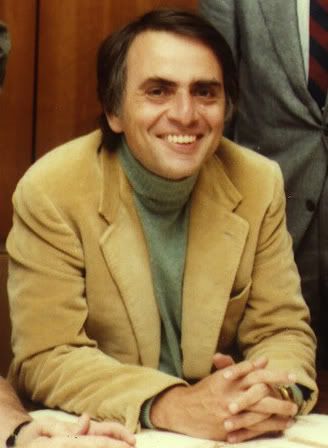
 Carl Sagan
Atheists are fond of dismissing Atheist Watch (My "other" blog) as my
own private hate fest. But the truth is I've been using it to construct a
theory of atheist psychology. The major conclusion I've reached so far
is that there is a calculated ideology that someone constructed (not to
sound so mysterious--by "someone" I don't mean atheists "men in black"
just the normal evolution of argument and the contributors to the same).
One of the standard leavers of that ideological/propagandist approaches
used in their movement is development of a standard for proof which
enables them to constantly raise the bar so no amount of evidence or
reasoning can ever count against their position. It's a rhetorical
device not a rule of logic!
Carl Sagan made this statement popular in its current form, it was
originally used by Hume, Laplace and other early theorists, but atheists
have sense taken it as a major slogan for their decision-making
paradigm.
Marcelo Truzzi tells us:
In his famous 1748 essay Of Miracles, the great skeptic David Hume
asserted that "A wise man...proportions his belief to the evidence,"and
he said of testimony for extraordinary claims that "the evidence,
resulting from the testimony, admits of a diminution, greater or less,
in proportion as the fact is more unusual." A similar statement was made
by Laplace, and many other later writers. I turned it into the now
popular phrase "extraordinary claims require extraordinary proof" (which
Carl Sagan popularized into what is almost the war cry of some
scoffers).
This slogan allows them to raise the bar for any Christian claim, while
lowering it for their own purposes. Ed J. Gracely explains the basic
logic of the bromide.
First, it is important to understand that the strength of a conclusion
is a function both of the quality of the evidence provided in its
support and the a priori probability of the claim being supported. Thus
there can never be a single standard of "acceptable evidence" that will
suffice to render every claim equally plausible. Suppose, for example,
that a reasonably reliable source tells me (a) that President Clinton
has vetoed legislation that places restrictions on trade with China and
(b) that Newt Gingrich has switched to the Democratic party. Most people
would be much more confident of the truth of the first report than of
the second, even though the source is identical. The difference lies in
the a priori plausibility of the claims.
A more precise formulation requires us to cast the a priori probability
of a claim into the form of "odds" in its favor. A proposition with 90%
probability of being true has 90 chances of being true for every 10 of
being false. Thus the odds are 90 to 10, which reduces to 9 to 1. A
proposition with 20% probability of being true has 20 chances of being
true for 80 of being false. The odds (in its favor) are 20 to 80 or 0.25
to 1. It is more natural to translate the latter case into odds of 4 to
1 against the proposition, but the calculations require us to work with
odds "in favor of" a proposition, even if they are fractional. Pieces
of evidence alter the odds in favor of a proposition by a multiplicative
factor in proportion to the quality of the evidence.
While it is clear that not all evidence weighs the same, some evidence
is better than other evidence, nothing in this explanation indicates why
evidence must be stronger for “extraordinary claims” than for “normal
claims.” Assuming we can even indicate what “extraordinary evidence” is,
what makes it more proven than “ordinary” evidence? The statement above
merely indicates that probability is higher for a proposition backed by
more direct evidence, nothing more. The rationale says that the least
likely proposition is less probable, then the assertion that the
evidence must be more “extraordinary” (whatever that means) rather than
just accurate or valid or to the point is not demonstrated. Most
assumptions about what makes evidence “extraordinary” or “ordinary,” or a
proposition likely or unlikely is going to be largely a matter of
prejudice. Consider the following statement, also by Gracely:
The principle is clear; the difficulty lies in the application. How
likely, for example, is it that homeopathy or therapeutic touch really
work? Proponents argue that we need to open our minds to new
possibilities and grant these systems a fairly high a priori probability
(say, 50-50 odds). Then, even modest-quality evidence would make the
claims quite probably true. Skeptics argue that these systems violate
known laws of physics and their validity should therefore be considered
remotely improbable.
Who decides how likely it is that homeopathy is valid or invalid
medicine? One would need a statical average for cure rates to compare
with controlled group using orthodox practices to see this. He admits
that “modest quality” evidence would be proof if it is granted a high
probability. Without the proper studies why not so grant? What if one
has found such treatments effective already in one’s own life? This is
nothing more than prejudice to judge something improbable on the basis
of guesswork and matters of taste. No that does not mean that believe
those forms of healing. Why shouldn’t a standard of evidence adequate
for proof of the issue under consideration, be the issue? I have so far
been unable to find an atheist who can tell me what extraordinary God
evidence is. I’ve seen attempts on message boards, where they argue
absurdities like “why can’t God make all the stars spell out the phrase
“burn pain is the worst pain, Jesus is Lord, convert now.” Or God could
appear at the UN and hold a press conference. I have yet to see an
atheist give me a valid option for “extraordinary evidence.” More
importantly, we are talking about God, not about finding Bigfoot. God is
off scale for empirical investigation. How can the basis of reality be
studied as though just another “thing” in creation? What could be used
as a basis of comparison? How could one ever establish a base line
comparison to determine probability of God? Dawkins tries it but he
merely assumes God would be on a par with any other physical object.
What basis is used to establish the probability of something that is
said to be beyond our understanding?
Gracely argues:
An alternative I have heard suggested is to drop the extraordinary proof
argument and instead to hold paranormal and alternative medicine claims
strictly to the ordinary requirements of replicability and good
research. This approach sounds sensible but it has a serious flaw.
Skeptics are not willing to accept the plausibility of most paranormal
claims unless the evidence is extremely strong. We risk being perceived
(correctly) as disingenuous if we call for solid quality research, then
revert to the extraordinary claims argument should it in fact
appear.(Ibid)
Correction, most skeptics are never willing to grant anything to para
normal claims regardless of the evidence, this is obvious to anyone who
has ever argued with atheists on message boards. I have 200 studies with
replicablity, double blind, proved comparison methods, published in
scholarly journals, peer reviewed and indexed, and the atheists on CARM
treat them like comic books. The only reason they nit pick to death
(ploys such as once attacking the bibliography becuase it had a source
they didn't like rather than looking at the studies themselves) is
becasue the studies contradict their world view.
This standard (normal scientific protocols) is the one I have been
proposing for years. The term he doesn’t use, the proper term for
“ordinary” level of proof would be a “prima facie case.” He may have a
point if we are talking about acupuncture or UFOs but the flaw he sees
in it is attitudinal, not logical or methodological. The attitude of
skeptics is out of line anyway. Atheists are not willing to accept any
level of evidence. The experience studies are fine studies, they are
scientific and a huge body of work backs them up. For all practical
purposes, they are “extraordinary evidence.” Let us not forget there is
no set standard any skeptic can offer to define that term. Skeptics are
quick to brush aside the experience studies as “subjective” without
reading the studies or thinking about the arguments. They never define
what “extraordinary” evidence would be. Gracely observes that skeptical
attitudes are similar even in other areas:
In some areas of paranormal investigation, such as extrasensory
perception (ESP), the research is already often better done than much
orthodox scientific research, with controls and double-checks most
scientists would regard as overkill. Skeptics mostly still feel that the
intrinsic implausibility is so great that nothing short of airtight and
well-repeated research would be sufficient to support ESP. Little or
none of the existing research rises to that level, so we remain
skeptical. (Some recent work has been of high quality, see Ray Hyman's
article, "The Evidence for Psychic Functioning: Claims vs. Reality", in
the March/April 1996 Skeptical Inquirer, pp 24-26.) Had skeptics said
some 40 years ago that all we wanted was reasonable quality replicated
research, we might now be having to eat our words.
Skeptics are never satisfied. I have seen this problem over and over
again. When their demands for evidence are met, they just raise the bar
again and again. The tyranny of “extraordinary evidence” so long as one
never defines it, allows for this sort of abuse all the time. More
importantly, why should God be subjected to the same standards of proof
as empirical objects? Here the skeptic is just in the position of
arguing “God is improbable because I don’t believe in him.” Truzzi
documents the “catch 22” designed into the extraordinary proof standard:
But it is important to remember that the proponent of the paranormal has
an uphill battle from the start. The chips are stacked against him, so
his assault is not so threatening to the fabric of science as scoffers
often characterize it. In a sense, conservative science has "the law" on
its side.
In law, we find three varieties in the weight of burden of proof:
1. proof by preponderance of evidence,
2. clear and convincing proof, and, in criminal law,
3. proof beyond a reasonable doubt.
In conventional science, we usually use (1), but when dealing with
extraordinary claims, critics often seem to demand (3) since they demand
all alternative explanations must be eliminated before the maverick
claim is acceptable. This demand sometimes becomes unreasonable and may
even make the scoffer's position unfalsifiable. Since the anomaly
proponent is already saddled with a presumption of "guilt," it would
seem to me that (2), clear and convincing proof, might be the best
standard, though proponents may reasonably wonder why standard (1)
should always be denied them.(Ibid)
The ploy just described is SOP for atheists on message boards. Since
every alternative, however unlikely, must be exhausted first, they will
put a 0.2% probability claim over a 50-50 claim any time just because
the alternatives must be exhausted and that means nothing ever has to be
granted to belief. In this way all other forms of knowledge bu the
pseudo science of the atheist ideology is rejected, thus the ideology of
the atheist and its propaganda protocols become like a template.This
serves to reinforce the ideology because all anyone need do is compare
the God argument to the template, or course it wont fit, it is then
judged "unscientific" (becasue the template has come to replace real
scientific procedure in the mind of the atheist) and thus all belief is
always wrong!
But we must also keep in mind that God is not “paranormal.” Truzzi and
Gracely are speaking in general of any sort of “paranormal” claim,
including the claims of alternative medicine. God is not paranormal, but
is status quo, normative for human belief. Nor is God a scientific
question. It is absurd to expect us to limit evidence to only the
scientific when the question about belief is epistemological. More on
this aspect of belief and it is import for evidential standards below.
But this does raise a further question about the extraordinary
evidential standard:
In addition to defining the term “extraordinary evidence” there is also a
need to define the term “extraordinary claim.” Why is God an
extraordinary claim? Here the atheist is truly in the position of
arguing “God is improbable because I don’t believe in him.” Atheists
make up 3% of the world’s population at best. The overwhelming
majorities of people alive today, or who have ever lived, believe in
some form of God. Our brains are hard wired to have thoughts of God. Our
physical and mental health work better when we believe in God (as will
be seen in latter chapters). Obviously we are fit for belief, why would
belief be extraordinary? Why should we allow the minor little 3%
minority to define what is normative for humanity? Belief in God is far
more than just the average belief; it is normative as a standard of
human understanding. It forms the basis of our psyches, it forms the
basis of our legal system; it is the chief metaphor regulating meaning
and morality. Belief in God illustrates all the aspects of a prima facie
case. This is at least so for RE. Marcelo Truzzi makes the same point:
The central problem however lies in the fact that "extraordinary" must
be relative to some things "ordinary." and as our theories change, what
was once extraordinary may become ordinary (best seen in now accepted
quantum effects that earlier were viewed as "impossible"). Many now
extraordinary claims may become more acceptable not when they are
replicated but when theoretical contexts change to make them more
welcome.(Ibid)
Of course what he's actually talking about is Thomas Kuhn's paradigm
shift. Trussi doesn't say it but what he described is basically that,
the way anomalies are absorbed into the paradigm and dismissed as
unimportant until there are too many and they are too problematic, the
paradigm shifts under it's own weight and the new paradigm is taken in;
the anomalies under the old become the "facts" under the new. Kuhn says
that a paradigm is defended just like a political regime. When it first
starts to show signs of are its followers do damage control just like
the Nixon White house under Watergate or the Reagan White house under
Iran/contra gate, or Bush under the lies about WMD. In a sense a
paradigm in scinece is propped up by an ideology that is driven by that
paradigm. In quasi scientific mimicry of atheism which flatters itself
as scientific, the paradigm of "physicalism" is surrounded by the
ideology of atheists that protects it. ECREE is just a propaganda device
that enables the ideology to knock off any counter claims.
Skeptics have argued that religious experience is not regular or
consistent because such experiences are all different. Not only do you
have so many different religions, but also even from mystic to mystic
things differ. Over the years as one develops a disciplined life of
prayer, one does encounter growing diversity and newness, but a certain
sense of the familiar as well. Experiences become regular and consistent
in that the presence of God is usually found in prayer, the sense of
the presence is always the of the same quality (although varying
intensity) and the sense of God can become familiar enough that it is
always recognized as the same, This sense of the familiar is
communicable and can be recognized form one believer to another. The
mystical and devotional literature presents a kind of ordered sameness.
One can read accounts as different form one experiencer to another as
those between St. Augustine and A.W. Tozer and still find passages that
seem to be talking about the same things. This is amplified times
millions of believers in the history of the church who have experienced
the same things. Even though there is diversification and difference
there is still sameness. This is not even confined to mystics. The same
can be said of conversion accounts that the same aspects keep popping
up. Once can recognize the work of God from one person to another, form
one time to the next, from one culture to all cultures. But, the skeptic
will ask, what about the vast array of different religions? These
differences are due to cultural constructs. One experiences God beyond
words, and when one tries to speak of such experiences one must encode
them in a symbolic universe, that is to say, in culture. These
differences in symbolic universes over time have spelled out the
differences in the many religions. But there is a cretin unity even
between all the differences in religion. The data presented long term
effects of religious experience (see articles on RE in this blog)
represents typologies, which can be used to compare "peak experience"
with that of other phenomena. The Peak experiencers can be grouped
together into a collection of those who have experiences X. They are not
isolated assortments of differing phenomena. These studies do represent
differing cultures and times. Thus, religious experience has a
consistency to it even between cultures.
Archetypal symbology universal.
Religions, Values, and Peak-Experiences. Abraham H. Maslow
Appendix I. An Example of B-Analysis
"...Jungian archetypes which can be recovered in several ways. I have
managed to get it in good introspects simply by asking them directly to
free associate to a particular symbol. The psychoanalytic literature, of
course, has many such reports. Practically every deep case history will
report such symbolic, archaic ways of viewing the woman, both in her
good aspects and her bad aspects. (Both the Jungians and the Kleinians
recognize the great and good mother and the witch mother as basic
archetypes.) Another way of getting at this is in terms of the
artificial dream that is suggested under hypnosis. It can also probably
be investigated by spontaneous drawings, as the art therapists have
pointed out. Still another possibility is the George Klein technique of
two cards very rapidly succeeding each other so that symbolism can be
studied. Any person who has been psychoanalyzed can fairly easily fall
into such symbolic or metaphorical thinking in his dreams or free
associations or fantasies or reveries.
Archetypal Symbology linked to Peak experience.
The link from Archetypes to religious experience is supplied by Maslow
as well, in a quotation already sited in Religious Experience Arguments.
He argues that the ability to relate "B knowledge" to "C knowledge"
where the female (Or the male) is balanced in the perception of the
other between goddess and whore, and the proper ego relation is sorted
out, is the managing of the sacred and profane. He points out that
anyone can learn to see in this manner and that it is indicative of
primitive people in their religious experiences as they explained the
world through the sense of the numinous.
d) Anyone can have peck experience --universal to humanity
Religions, Values, and Peak-Experiences
Abraham H. Maslow
Appendix D. What is the Validity of Knowledge Gained in Peak-Experiences?
"To summarize, the major changes in the status of the problem of the
validity of B-knowledge, or illumination-knowledge, are: (A) shifting it
away from the question of the reality of angels, etc., i.e.,
naturalizing the question; (B) affirming experientially valid knowledge,
the intrinsic validity of the enlarging of consciousness, i.e., of a
wider range of experiencing; (C) realizing that the knowledge revealed
was there all the time, ready to be perceived, if only the perceiver
were "up to it," ready for it. This is a change in perspicuity, in the
efficiency of the perceiver, in his spectacles, so to speak, not a
change in the nature of reality or the invention of a new piece of
reality which wasn't there before. The word "psychedelic"
(consciousness-expanding) may be used here. Finally, (D) this kind of
knowledge can be achieved in other ways; we need not rely solely on
peak-experiences or peak-producing drugs for its attainment. There are
more sober and laborious—and perhaps, therefore, better in some ways in
the long run—avenues to achieving transcendent knowledge (B-knowledge).
That is, I think we shall handle the problem better if we stress
ontology and epistemology rather than the triggers and the stimuli."
2) Why Does God seem Hidden to SO many people?
a) God is not strictly speaking "invisable."
According to Hartshorne, "[o]nly God can be so universally important
that no subject can ever wholly fail or ever have failed to be aware of
him (in however dim or unreflective fashion)." Now the issue of why God
doesn't hold a "press conference" has do do with the fact that God does
not communicate by violating normal causal principles. In process terms,
the "communication" of God must be understood as the prehension of God
by human beings. A "prehension" is the response of an occasion to the
entire past world (both the contiguous past and the remote past.) As God
is in every occasion's past actual world, every occasion must "prehend"
or take account of God.
It should be noted that "prehension" is a generic mode of perception
that does not necessarily entail consciousness or sensory experience. In
previous postings I explained that there a two modes of pure perception
--"perception in the mode of causal efficacy" and "perception in the
mode of presentational immediacy." If God is present to us, then it is
in the presensory perceptual mode of causal efficacy as opposed to the
sensory and conscious perceptual mode of presentational immediacy. That
is why God is "invisible", i.e. invisible to sense perception. The
foundation for experience of God lies in the nonsesnory nonconscious
mode of prehension. So now, there is the further question: Why is there
variability in our experience of God?. Or, why are some of us atheists,
pantheists, theists, etc.? Every prehension has an initial datum derived
from God, yet there are a multiplicity of ways in which this datum is
prehended from diverse perspectives.
I agreed with Hume that sense perception tells us nothing about
efficient causation (or final causation for that matter). Hume was
actually presupposing causal efficacy in his attempt to deny it (i.e.,
in his relating of sense impressions to awareness). Causation could be
described as an element of experience, but as Whitehead explains, this
experience is not sensory experience. From Hume's own analysis Whitehead
derives at least two forms of nonsensory perception: the perception of
our own body and the nonsensory perception of one's past.
b). Atheists basically deny the validity of religious experience because they assume that all perception is sense perception.
Or, they deny sense perception to theists when they actually presuppose it themselves (Hume is a case in point).
c) All people experience the reality of God or the "Holy" all the time.
But this is at an unconscious level. However, in some people, this
direct prehension of the "Holy" rises to the level of conscious
experience. We generally call theses people "mystics". Now, the reason
why a few people are conscious of God is not the result of God violating
causal principle; some people are just able to conform to God's initial
datum in greater degree than other people can. I don't think that God
chooses to make himself consciously known to some and not to others.
That would make God an elitist. Now, the question as to why I am a
theist as opposed to an atheist does not have to do with me experiencing
some exceptional religious or mystical experience. Rather, I believe
that these extraordinary experiences of the great religious leaders are
genuine and that they do conform to the ultimate nature of things. It's
not necessarily a "blind leap" of faith, as my religious beliefs are
accepted, in part, on the basis of whether or not they illuminate my
experience of reality.
The upshot of all of this is religious belief is normative for human
behavior. It is not merely "normal" but "normative" meaning it sets the
standard. Belief is basic to human psyche, to our understanding of the
good, of meaning in life, the ultiamte limits of reality, the grounding
of nature and being itself, there is no way belie in God can be thought
of as an extraordinary claim! We might think of it as extraordinary in
the the sense of being unique, like no other claim, but in that case it
makes no sense to subject it to the regular canons of science as though
God's presence is given in daily empirical data. Obviously the more
intelligent evidential standard is that the evidence has to be fit for
the claim. Fit, not dazzling, not impossible, not amazing, no beyond our
ability to produce, but it has to fit the case. It has to be rational,
and able to stand a prima facie burden, and it has to fit the proof
attempted.
Thus the atheist ploy has achieved a standard where all other forms of
evidence save scientific data, why they blithely refer to as "facts,"
can be used to bolster certain shallow claims of "proof" for a straw man
world view that is quasi scientific and supposedly an alternative to
religious belief while denigrating all other forms of knowledge
(including scinece that doesn't agree with them) save the selective list
of "facts" deemed pertinent to their case. The effect being that
civilization take one more hit as all forms of thinking and knowledge
are eliminated save this one, a quasi-scientific approach to knowledge
which is ideological in both tone and function.
Part 2 of the argument "more contra ECREP"
sources:
Marcelo Truzzi “on some unfair practices toward claims of the
Paranormal.” This article was published in slightly edited form
in:Edward Binkowski, editor, Oxymoron: Annual Thematic Anthology of the
Arts and Sciences, Vol.2: The Fringe, New York: Oxymoron Media, Inc.,
1998. It is also found on the website Skeptical Investigations:
http://www.skepticalinvestigations.org/anomalistics/practices.htm
visited 7/7/08
on line version of Truzzi article
Ed J. Gracely ”Why Extraordinary Claims Demand Extraordinary Proof. This
article first appeared in the December 1998 issue of Phactum, the
newsletter of the Philadelphia Association for Critical Thinking
(PhACT). Dr. Gracely is Associate Professor of Community and Preventive
Medicine at the MCP*Hahnemann School of Medicine in Philadelphia. This
article was posted on July 24, 2003. It is now found on:Quackwatch
http://www.quackwatch.org/01QuackeryRelatedTopics/extraproof.html
Abraham MaslowReligious Values and peak Experience,
text online: http://www.druglibrary.org/schaffer/lsd/maslow.htm
url for my RE argument: http://www.doxa.ws/experience/mystical.html
 by QuantumTroll on Tue Nov 20, 2012 4:08 am


