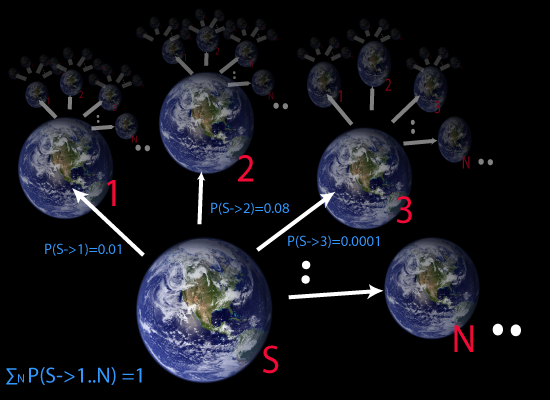
 possible worlds
Over the last couple of decades atheists
have been so put up on by God arguments and the success of thinkers
such as Plantinga, Alston and Hartshorne that they have become
radicalized in their attempts at making anti-God arguments. I have hunch
that they basically see God arguemnts as a trick. I've actually seen
atheists at the popular level refer to logic as a trick. They don't take
God arguments seriously yet seem intimidated by the use of logic. This
has led to a plethora of attempted anti-God arguments, disproofs that
seek to pit the concepts of religious thinking against each other to
produce seeming contradictions. One of the more legigitate academic
attempts in this vain is due to the efforts of
J.L. Schellenberg, who is a philosopher form Canada. Some of his published works include:
Prolegomena to a Philosophy of Religion. Ithaca: Cornell University Press, 2005.
The Wisdom to Doubt: A Justification of Religious Skepticism. Ithaca: Cornell University Press, 2007
The Will to Imagine: A Justification of Skeptical Religion. Ithaca: Cornell University Press, 2009.
Schellenberg
is one of the leading voices in the atheist attempt to flood the net
with ant-God arguments hat seek to turn dobout toward conflicting
concepts and questions regarding the logic of God arguments. Below are a
few examples of his and other arguments. These are arguments I've seen
atheists use on boards that are attributed to Schellenberg. The teaches
at Mount Saint Vincent University, in Nova Scotia.
The Argument from Horrific Suffering (J. L. Schellenberg):
Horrific Suffering (def.) = that most awe-full form of suffering that
gives the victim and/or the perpetrator a prima facie reason to think
that his or her life is not worth living.
(1) Necessarily, if God exists, finite persons who ever more fully experience the reality of God realize their deepest good.
(2) Necessarily, if God exists, the prevention of horrific suffering
does not prevent there being finite persons who ever more fully
experience the reality of God.
(3) Necessarily, if God exists, the prevention of horrific suffering
does not prevent there being finite persons who realize their deepest
good. (from 1, 2)
(4) Necessarily, if God exists, there is horrific suffering only if its
prevention would prevent there being finite persons who realize their
deepest good.
(5) Necessarily, if God exists, there is no horrific suffering. (from 3, 4)
(6) There is horrific suffering.
(7) God does not exist (from 5, 6)
....This
argument seems to turn on a hidden premise that God allows suffering
and evil so that some ultimate good might exist. That's the really
premise as to why God would allow suffering, the argument asserts a
second hidden premise that a good God would stop the worse forms of pain
and suffering if his aims could be achieved without. It then cliams to
know what that ultimate good is, thus asserts the stated premises that
the good could be achieved without allowing such suffering. The argument
as a whole says God can allow us to know him fully and achieve the
highest good without allowing the worst forms of suffering, thus their
existence in the world is an arguemnt against God's existence.
....P1
asserts that the greatest good is knowing God: "finite persons who ever
more fully experience the reality of God realize their deepest good."
It shows asserts that this can happen without the most horrific forms of
suffering, thus such forms of suffering in so far as they do exist
stand out against God's existence. There's a lot wrong with this
argument:
(1) It asserts to know things we don't. We an
asserting knowing God is our highest good but how that plays into God's
plan for creation we can't assert to know so confidently as to assert
to know that it can b acheied without allowing horrifc evil.
(2)
It asserts to know that the most horrific forms of evil are not
prevented. We don't know the most horrific forms. If God is protecting
us and preventing the most horrific forms of evil how can we know? they
don't exist in our world so we don't know.
(3) The argument is basically taken out by my
soteriological drama
which says that God wants us to search for truth so that we can
internalize the values of the good. The risk that we make the wrong
choices must be open or there's no search. Thus it's not a matter of
balance good against evil, nor is it a matter of needing evil to know
good, but of risking evil so we can choose the good freely. In so doing
the most horrific forms of evil (that we know of) must be part of the
risk. If God habitually prevented the most horrific kinds of evil it
would soon become apparent that there is a supernatural force protecting
us and there would be no search.
(4) the argument
turns upon premise (5) "Necessarily, if God exists, there is no horrific
suffering. (from 3, 4)" what does these say?
(3) Necessarily, if God exists, the prevention of horrific suffering
does not prevent there being finite persons who realize their deepest
good. (from 1, 2)
(4) Necessarily, if God exists, there is horrific suffering only if its
prevention would prevent there being finite persons who realize their
deepest good.
....P3 is
where I get the notion of hidden premises. Why would the
prevention of horrific suffering be said to prevent finite persons
realizing the deepest good? He must be expecting an answer of this as
the reason for the allowing of horrific suffering...yet it doesn't
preclude the need to run the risk in order to internalize the values
through the search. So the objection stands but in a somewhat different
from, one that his argument doesn't prevent. P4 this an explicit
statement of what I felt was a hidden premise that the conflict is
bewteen realizing the deepest good vs allowing horrific evil. The whole
argument turns upon asserting that horrific evil can be prevented and
the deepest good be accomplished. We don't need the most horrific evil
so good God would not allow it. That doesn't answer the issues that I've
raised. That we might question if the most horrific evil does exist,
(after all, Hitler didn't win WWII, the cold war didn't produce nuclear
war, and George Wallace did not win the 1968 Presidential election) and
that there is still need to risk the doing of abhorrent evil in order to
necessitate the search.
This next argument is still really a version of the first one, it's just tweaking it to induce the aspect of hiddeness.
Argument from Divine Hiddeness (Also from J.L. Schellenberg):
(1) If a perfectly loving God G exists, then for any human subject S at
time t, if S is at t capable of relating personally to G, S at t
believes that G exists on the basis of evidence that renders the
existence of G probable, except insofar as S is culpably in a contrary
position at t.
(2) There exists at least one human subject S who at time t does not
believe that G exists on the basis of evidence that renders the
existence of G probable and who is not culpably in a contrary position
at t.
(3) No perfectly loving God exists.
....He's
made it more complex with the use of symbols. I know this is done to
make it more efficient to disuses repeated concepts but it doesn't. I
have quoted he original argument so I will re word in a way that I think
makes it more understandable.
....This
argument is essentially saying that if there is an individual who
doesn't find God to be real on the basis of evidence then we can
asserting there is no loving God because if God was loving he would want
everyone to know. There are numerous problems. Again a hidden premise,
that God's love means everyone must believe at the same time. Of course
the background assumption that we must have instant gratification, life
is not a journey so that everyone must believe at all times and have the
same outcomes. It would also seem that this argument is made to counter
a more traditional view of Christianity that sees hell and damnation
and eternal conscious torment as the consequence of unbelief. If we take
that result out of the picture and look at life as journey of learning
which culminates in our own successful search for the answers, then
there is no need to assert that everyone must believe at the same time
or there's no good God.
....It would also seem that he's missed the point about hiddeness. If my guess is right and Gods
apparent hiddeness
is in order to facilitae the search so that we might internallize the
values of the good, then there is no ultimate contradiction between
God's hiddeness and the need for salvation. The apparent hidden state of
God is not an impediment to belief but rather an inducement to search.
This one is not by Schellenberg, but Mark Walker, New Mexico State University.
The Anthropic Argument against the existence of God (Mark Walker):
This argument uses a moral scale. 0 is perfectly immoral and 10 is
perfectly moral S is the set of all possible worlds which is populated
only by beings greater than 5 on the scale.
(1) God is omnipotent
(2) So, it is possible for God to actualize a member of S
(3) God is omniscient
(4) So, if it is possible for God to actualize a member of S, then God knows that He can actualize a member of S
(5) So, God knows that He can actualize a member of S
(6) God is morally perfect
(7) So, a morally perfect being should attempt to maximize the
likelihood of moral goodness and minimize the likelihood of moral evil
in the world
(8) If God knows He can actualize a member of S, then every world in which God exists is a member of S
(9) Therefore, every world in which God exists is a member of S
(10) Therefore, if God exists in the actual world then the actual world is a member of S
(11) The actual world is not a member of S
(12) Therefore, an omnipotent, omniscient, morally perfect God does not exist.
And then there's the
Argument from Dwindling Probabilities (Alvin Plantinga)
in which he concludes "The conclusion to be drawn, I think, is that K,
our background knowledge, historical and otherwise (excluding what we
know by way of faith or revelation), isn't anywhere nearly sufficient to
support serious belief in G."
An abstract version of the argument from
Sophia:
If God is morally perfect then He must perform the morally best actions,
but creating humans is not the morally best action. If this line of
reasoning can be maintained then the mere fact that humans exist
contradicts the claim that God exists. This is the ‘anthropic argument’.
The anthropic argument, is related to, but distinct from, the
traditional argument from evil. The anthropic argument forces us to
consider the ‘creation question’: why did God not create other gods
rather than (...)[1]
....Here
we have an example of the flawed possible worlds thinking that atheists
have employed to overwhelm Plantinga's possible world's argument. I use
a version of Plantinga's possible worlds argument
on my 42 argument list on Doxa. It's no 14 on my list. The argument
essentially says that God is such that he can't just be necessary in one
possible word but if he exists he must be necessary in all possible
worlds. That means he has to be necessary here, in this world. the
issue is there's nothing to stop the cocnept that God is necessary in
all possible worlds. The argument turns upon the premise that there has
to be some possible world in which God is necessary. If there is such a
world then for him to be God and to be necessary in a true sense he must
have to be necessary in all possible worlds, including this one. The
issue is that this is mandated, it is the case logically speaking so it'
snot something that can be negated if the premise are true. The point
of the argument is to drive home the implication of the model argument
that there is no maybe with God; either God is necessary or impossible
but since he can't be contingent there's no "maybe he exits and maybe he
doesn't. He exists for sure or he can't exist logically becuase he's
impossible. Thus if he's not impossible then he has to exist.
....The
atheists decided what we have to do is come up with a world in which
there could not possibly be a God. They assert this can be done by
imagining it because the foolishly assume that "possible world" means
any world i can imagine. They assume they are imagining such a world by
thinking about his one because they dont' believe in God anyway. Since
the point is to prove that God must exist in this world that's actually
circular reasoning n the atheists part. These anti-God possible world
arguments all do this, they assume that the formation of an imaginary
world that is imagined without God, without having to work out all the
other philosophical details that build God arguments, based upon the
pretense that we live in such a possible world (without God--when in
fact that's what is under dispute) controls the essence of God and makes
him not exist, so to speak. The shape the concept of God around the
need to imagine that we are in a possible world in which there is no
God.
....The problems with the above
arguemnt are several. The argument is a good example of an arguemnt in
when they try to just imagine into existence a possible world of no God
becuase they model it on their disbelief.
(1) It's
three arguments in one that each is nested in the other to make it hard
to deal with them as one coherent arguemnt. It really should be broken
up. It's a moral argument, its about contradictions of omnipotence and
omniscience, it's about possible worlds.
(2) The
omniscience and omnipotence are used as "plan spikes" (we use to call
them in debate) to negate possible answers; God must know this is goign t
be the case and has to negate it or he's not just trying becuase he
would know and he would be able to. That ignores the real reasons for
taking the risk that we make the wrong choices (of course God would know
we are going to). Again, my soteriological drama, free will is
necessary to morality so that we may freely choose the good; we can't
make moral decisions without freely choosing to. Not a matter of God not
knowing it, it's a matter of having to take the risk because we must be
allowed to choose; they never calculate the fact that God can
understand the balance sheet and see that it's worth it. That point
alone destroys the whole argument.
(3) the argument
turns upon this premise: (9) "Therefore, every world in which God exists
is a member of S. S is the perfectly moral world populated only by
those whose morality exceeds 5. He doesn't use the scale in the actual
argument. We also don't know the values that make up the scale so that
might tip the argument if we knew what he was calculating.
(4)
P9 is the turning point and it means it's also the defeat of the
argument. It's based upon the question begging premise. To be true P9
must assert the conclusion of the argument to make the argument, that
God would only allow possible worlds with S content. If god must risk
our evil choice as a matter of our freely choosing the good they can
hardly restrict planetary formation to S worlds.
(5)
The argument doesn't account for the search. It's assumes static worlds
where everyone has achieve moral perfection at the same time. It doesn't
take life as a journey or individual lives as individual searches for
truth. Everyone has to be in the same place at the same time.
(6)
Edward Feser has some important things to say about these possible
worlds arguments; they have it backwards, the essence of God is not
controlled by possible worlds.
It is also often said that for God to be a necessary being is for Him to
exist in every possible world. This too is at least very misleading. It
leaves the impression that there are these things called “possible
worlds” that have some kind of reality apart from God, and it turns out –
what do you know! – that God happens to exist in every one of them,
right alongside numbers, universals, and other necessarily existing
abstract objects. To be sure, since possible worlds other than the
actual one are themselves mere abstractions (unless you are David Lewis),
they would not exist as concrete entities that God has not created. But
the “possible worlds” account of God’s necessity nevertheless
insinuates that that necessity is grounded in something other than God
Himself – that what is possible or necessary in general is to be
determined independently of God, with God’s own necessity in turn
defined by reference to these independent criteria. For A-T, this is
completely muddled. The reason God is necessary is that He is Pure Act
or Subsistent Being Itself, not because He “exists in every possible
world.” And since God just is Being Itself – rather than “a being” among
other beings, existing in one possible world or in all – all
possibilities and necessities whatsoever are themselves grounded in the
divine nature, rather than in anything in any way independent of God.[2]
....All
of these argumetns, this entire approach, the moral conflicts anti-God
arguments the possible worlds anti-God argumetns, with their attempt to
control God's essence by indexing it to possible worlds rather than vice
versa, it's a grand example of what Tillich talked about when he said
that if we know being has depth we know God has to be. That means if
there is more to being alive and existing thus just the mere fact of
existence then we know there has to be God becuase God is the depth of
being, God is that "more to it." The atheist thinking on this score is a
good example of what Tillich talks about when he speaks of the "surface
level." The atheist says life is just a straight up proposition of it
exists or it doesn't, either the world is morally perfect as an
extension of a moral perfect creator or it's not, in which case there is
no morally perfect creator. That's just the surface level of existing
or not existing. It fails to take into account the meaning of life, the
meaning of what it means to be. What it means to be is to be the
creature of a necessary creator, thus our contingency is proof of a
transcendent necessity that makes the "something more."
....They
can't assert that their unbelief is proof of a Godless universe then
use that as a proof of a possible world of no God, especially when they
mere ignore the depth in being that tell us there more to being than
just the surface issue of apparent existence. The nature of possible
worlds does not determine the nature of God, it is God who determines
possible worlds. Philospher J.N. Findlay was the first to tray and
reverse the ontological argument as a disproof of God. He admitted at
the time that Hartshorne had convienced him that his argument led to a
ready inversion that this is what set up the realization that if God is
at all possible then he must be necessary. The original attempt winds up
in disproof of the reversal and brings the modal argument back rightly.
Professor Hartshorne has, however, convinced me that my argument
permits a ready inversion, and that one can very well argue that if
God's existence is in any way possible, then it is also certain and
necessary that God exists, a position which should give some comfort to
the shade of Anselm. The notion of God, like the notion of the class of
all classes not members of themselves, has plainly unique logical
properties, and I do not now think that my article finally decides how
we should cope with such uniqueness.[3]
That's still the case now and it will always be so.
[1] Mark Walker, "Anthropic Argument Againt the Existence of God,"
Sophia, 48 (4) 351-378
[2] Edward Feser, "God and Possible Worlds," Edward Feser Blog (June 6, 2010): URL:
http://edwardfeser.blogspot.com/2010/06/god-and-possible-worlds.html
[3] J.N. Findlay, "Can God's Existence Be Disproved?" Di Text URL:
http://www.ditext.com/findlay/god.html


